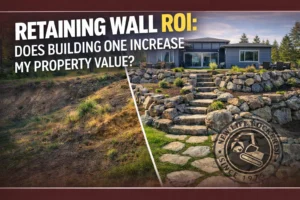
When you look at a sloping backyard or an eroding hillside, you see a problem. You see mudslides during heavy rains, unusable space where the kids can’t play, and a landscape that looks unkempt.
But when you look at the quote for a professional retaining wall contractor, you likely see something else: a significant expense.
For homeowners and business owners alike, the hesitation is natural. Is a retaining wall just a sunk cost—a necessary repair like a new water heater that no one notices? Or is it an investment that puts money back in your pocket when you sell?
The short answer is yes, a retaining wall generally increases property value.
However, unlike a kitchen renovation where the value is aesthetic, the Return on Investment (ROI) of a retaining wall comes from three specific areas: structural security, curb appeal, and the creation of usable square footage.
This guide breaks down exactly how retaining walls impact your home’s market value, which materials offer the best returns, and how to ensure you don’t lose money on a bad installation.
The Core Value Proposition: Usable Square Footage
In real estate, square footage is king. While we typically think of this in terms of indoor living space, outdoor “living” space is increasingly valuable, especially in regions with hilly terrain.
If you have a sloped yard, you are paying property taxes on land you cannot use. A steep hill isn’t a place for a patio, a garden, or a play set. It is essentially dead space.
The “Terracing” Effect
A retaining wall transforms a slope into a flat plane. By cutting into the hillside and supporting the earth, you create a terrace. Suddenly, a 30-degree slope becomes a flat, 500-square-foot lawn or a leveled area for a hardscape patio.
When an appraiser or a potential buyer looks at your property, they see “functional” yard space. In competitive housing markets, a flat, usable backyard can command a premium of 10% to 20% over a home with a steep, unusable slope, often recovering more than 100% of the cost of the wall itself.
Protection: The Value of Preventing Depreciation
ROI isn’t just about making money; it is also about preventing the loss of money.
Slopes are unstable by nature. Gravity, combined with water, constantly pulls soil downhill. Without a retaining wall, this leads to:
-
Erosion: Topsoil washing away, ruining gardens and exposing roots.
-
Foundation Damage: If the soil supporting your home shifts, your foundation creates cracks.
-
Drainage Issues: Water pooling against your home’s siding or basement.
If you list your home for sale, a home inspector will flag erosion or negative grading (water flowing toward the house) immediately. This creates a “red flag” that forces you to lower your asking price or pay for expensive retaining wall repairs during closing.
A professionally engineered retaining wall eliminates these liabilities. It signals to a buyer that the property is structurally sound, stable, and safe from water damage.
Comparing Materials: Which Type Offers the Best ROI?
Not all walls are created equal. The material you choose affects the upfront cost, the lifespan, and the final aesthetic—all of which determine your ROI.
For a detailed breakdown of 2026 pricing, read our guide on Retaining Wall Costs in Seattle.
1. Natural Stone and Rockeries
ROI Potential: High Large boulders (basalt or granite) offer a timeless, premium look. Because natural stone is incredibly durable and drains well naturally, rockeries rarely fail if built correctly. They fit high-end aesthetics and increase curb appeal significantly.
-
Pros: Lifetime durability, premium look.
-
Cons: Higher installation cost due to heavy machinery requirements.
2. Interlocking Concrete Blocks (Segmental Walls)
ROI Potential: Moderate to High These are engineered blocks designed specifically for retaining earth. They come in various colors and textures. They provide a clean, manicured look that appeals to most buyers. (See our guide on how block walls are built to understand the structural advantages).
-
Pros: Extremely strong, consistent look, long warranties.
-
Cons: Can look “commercial” if not designed with landscaping in mind.
3. Timber and Railroad Ties
ROI Potential: Low Wood is the cheapest material upfront, but it has the worst ROI. Railroad tie walls eventually rot. In a damp climate, a timber wall may only last 10–15 years.
-
Pros: Cheap, rustic look.
-
Cons: If you sell your house 10 years after building it, the wall may already be failing, becoming a liability for the buyer rather than an asset.
4. Poured Concrete
ROI Potential: Moderate Poured concrete is modern and strong but very expensive. It is prone to cracking if the ground shifts, which can be an eyesore that is expensive to patch.
The “Curb Appeal” Factor
First impressions translate to dollars. A crumbling hillside looks neglected. A tiered retaining wall filled with vibrant landscaping looks managed and expensive.
According to data from real estate studies, homes with high “curb appeal” tend to sell for 7% more on average than similar houses with uninviting exteriors. In slower markets, that figure can jump to 14%.
A retaining wall creates structure. It provides a frame for flower beds, shrubs, and lighting. It turns a wild, unmanageable yard into an architectural feature.
When a Retaining Wall is a BAD Investment
There are scenarios where building a wall will not yield a positive financial return.
1. The DIY Disaster If you build a wall yourself and it leans, bulges, or lacks drainage, you have essentially thrown money away. A home inspector will identify a failing DIY wall immediately. You may be forced to pay to have it removed before the sale can close.
2. Over-Improvement for the Neighborhood If you live in a starter-home neighborhood and spend $50,000 on imported Italian stone walls, you likely won’t recover that cost. The improvement must match the value tier of the home.
3. Ignoring Drainage A wall without a drainage pipe and gravel backfill is a ticking time bomb. If the wall traps water, it creates a swamp in your yard. This lowers property value.
The Process: What to Expect When Hiring a Pro
If you decide to proceed, understanding the workflow helps you manage the timeline and vetting process.
-
Site Assessment: A contractor evaluates the slope, soil type (clay vs. sandy), and access.
-
Engineering & Permits: Walls over a certain height (often 4 feet) usually require a permit and a structural engineer’s stamp. This ensures the wall won’t collapse under the weight of the soil.
-
Excavation: The slope is cut back, and a trench is dug for the footer.
-
Base Installation: This is the most critical step. A compacted gravel base prevents the wall from sinking.
-
Drainage Installation: Perforated pipes and drainage aggregate are installed behind the wall to manage water pressure.
-
Construction: The wall materials are stacked or poured.
-
Backfill & Grading: The area behind the wall is filled, and the final grade is set.
Timeline: Most residential projects take between 1 and 2 weeks, depending on weather and complexity.
Frequently Asked Questions
How much value does a retaining wall add? While it varies by market, landscaping upgrades that add usability (like terraces) typically recover 100% to 150% of their cost upon resale.
Does a retaining wall require maintenance? Stone and concrete walls are virtually maintenance-free. Timber walls require checking for rot and pest infestation. All walls should be checked annually to ensure drainage pipes are not clogged.
Is a permit really necessary? Yes. If you build a significant wall without a permit, you may face fines or be ordered to tear it down. Furthermore, unpermitted work must be disclosed to future buyers, which can kill a sale.
Can I build a retaining wall on my property line? Usually, yes, but you often need a survey to ensure you aren’t encroaching on your neighbor’s land. In some jurisdictions, you can build right up to the line; in others, there is a required setback.
Conclusion: Is It Worth It?
If your property has a slope that limits your ability to use your yard, or if you are seeing signs of erosion threatening your foundation, a retaining wall is one of the safest investments you can make.
It converts “dead” land into “living” land. It protects the structural integrity of your home. And, when done with the right materials, it adds immediate visual appeal that buyers are willing to pay for.
The key to ROI is longevity. A cheap wall that fails in five years costs you double. A professionally engineered wall that lasts fifty years is an asset for life.
If you are ready to evaluate your slope and see what options fit your budget, please contact us for a professional assessment.