
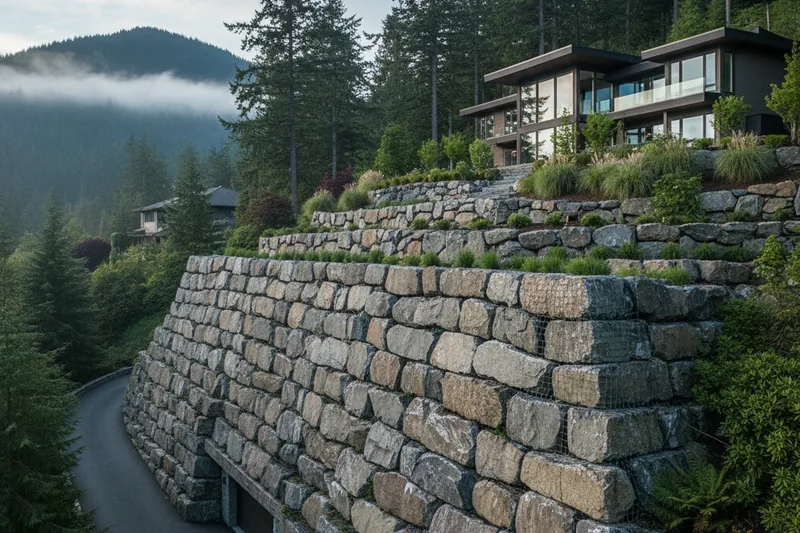
Engineered for Gravity: When to Use Anchored vs. Gravity Retaining Walls

Engineered for Gravity: When to Use Anchored vs. Gravity Retaining Walls

Request a Quote

Engineered for Gravity: When to Use Anchored vs. Gravity Retaining Walls

Gravity retaining walls use dead weight to resist soil pressure — best for walls under 10 ft with good soil and a wide footprint. Anchored retaining walls use tiebacks that engineers drill into stable ground — the right choice for walls over 10–15 ft, poor soils, heavy loads, or tight urban sites. Both systems work well in the right conditions; however, anchored walls always require a licensed engineer to design them.

Not every retaining walls seattle is created equal. When the ground starts pushing back — and it always does — the difference between the right wall and the wrong one can mean the difference between a stable hillside and a costly failure.

Gravity walls and anchored retaining walls both solve earth-retention problems. But they operate on fundamentally different engineering principles. One relies on sheer mass. The other borrows strength from the earth itself.

This guide walks through how each system works, when to use it, and how to choose between them — so you make the right call before the first bucket of soil moves.

Why Retaining Wall Type Matters

Every retaining wall is fighting the same enemy: lateral earth pressure.

This is the horizontal force that saturated, loaded, or expansive soil exerts against a wall face. Left unresisted, it causes walls to slide, tilt, or fail — sometimes suddenly.

Two dominant strategies exist for resisting that force:

  • Use enough dead weight that the wall cannot be pushed over (gravity approach)
  • Anchor the wall into stable ground far behind the failure plane (anchored approach)


Choosing the wrong strategy doesn’t just cost money — it creates liability.

Gravity Retaining Walls: Mass as the Solution

A gravity retaining wall does exactly what its name suggests: it uses gravity — specifically, the wall’s own weight — to resist lateral soil forces. No anchors, no tiebacks, no tension elements. Just bulk.

How Gravity Walls Work

The wall’s mass creates downward force. That downward force generates friction at the base, which resists sliding. Combined with the wall’s geometry, this prevents overturning.

The wider and heavier the wall, the more pressure it can hold back. That’s the whole principle.

Common Gravity Wall Materials

  • Poured concrete (plain or mass concrete)
  • Dry-stacked or mortared stone
  • Gabion baskets (wire mesh filled with rock)
  • Large segmental concrete blocks
  • Crib walls (interlocking timber or precast concrete units)

When to Use a Gravity Wall

  • Wall height is under 10 feet (3 meters)
  • Adequate space for a wide base — typically 50–70% of wall height
  • Soils are stable, well-drained, and predictable
  • Surcharge loads (vehicles, structures, stored materials) are light or absent
  • Budget favors simplicity over engineered complexity


Critical Limitation: As wall height increases, required mass increases exponentially — not linearly. A gravity wall designed to hold back 20 feet of soil would be enormous and prohibitively expensive. This is the point where anchored systems become both necessary and more cost-effective.

Anchored Retaining Walls: Borrowing Strength from the Earth

An anchored retaining wall — also called a tieback wall — transfers lateral soil loads into stable ground behind the active failure zone. The wall face itself can be relatively thin. It’s the anchoring system that provides the strength.

This is a fundamentally different engineering philosophy: instead of adding mass at the wall, you reach behind the problem and hold it in place.

How Anchored Walls Work

Steel anchors (typically grouted tendons or bars) are drilled beyond the theoretical failure plane into passive or competent soil or rock. They’re then stressed to apply preload — actively engaging the retained mass before it can move.

The wall face transmits load to the anchors. The anchors transmit load to stable earth. The system works together.

Types of Anchored Systems

  • Grouted tiebacks (prestressed ground anchors) — Most common for permanent structures; drilled and grouted into rock or dense soil
  • Soil nails — Passive anchors drilled into existing soil; ideal for top-down construction and slope stabilization
  • Deadman anchors — Buried plates or masses connected to the wall by rods; used where drilling isn’t practical
  • Sheet pile + waler — Driven steel sheet pile combined with a horizontal waler beam and tieback rods

When an Anchored Retaining Wall Is Required

  • Wall height exceeds 10–15 feet
  • Site is constrained and a wide base is impossible (urban infill, cuts, tight lots)
  • Soil conditions are poor, loose, expansive, or variable
  • Heavy surcharge loads are present — roads, buildings, rail, stockpiles
  • Seismic zone requirements demand superior lateral resistance
  • Deep basement or cut slope construction is proceeding top-down


Engineering Note: Every anchored retaining wall must be designed by a licensed geotechnical or structural engineer. Anchor load testing, corrosion protection design, and long-term monitoring plans are standard components of a code-compliant anchored wall system.

Gravity Wall vs. Anchored Retaining Wall: Full Comparison

Use this table when evaluating wall type in early project planning. Every factor below can shift the specification.

Factor
Gravity Wall
Anchored Retaining Wall
Primary mechanism
Dead weight & friction
Tiebacks / anchors into stable earth
Ideal wall height
Up to 10 ft (3 m)
10 ft – 30+ ft
Footprint needed
Wide base (50–70% of height)
Minimal — vertical or near-vertical
Best soil conditions
Stable, well-drained
Poor, loose, expansive, or variable
Surcharge loads
Light only
Heavy — roads, structures, stockpiles
Engineering required
Often minimal
Always — licensed engineer required
Seismic performance
Moderate
Superior — anchors resist lateral forces
Typical cost
Lower upfront
Higher upfront, better lifecycle value
Construction speed
Fast & simple
Slower — specialist equipment needed
Common materials
Concrete, stone, gabion, block
Steel tendons, grout, concrete facing

Which Wall Do You Need? The Decision Framework

Most wall specifications come down to four questions. Answer them in order:

  1. How tall is the wall? Over 10 ft — go anchored. Under 10 ft — gravity may work.
  2. What are the soil conditions? Poor, loose, or expansive soils require an anchored system.
  3. What surcharge loads apply? Heavy loads (roads, structures) require engineered anchoring.
  4. How much footprint is available? Tight sites demand an anchored wall’s minimal base width.
✓ Choose a Gravity Wall When…
✓ Choose an Anchored Retaining Wall When…

âś“ Height is under 10 ft
âś“ Soils are stable and well-drained

âś“ Wide base footprint is available

âś“ Loads are light

âś“ Budget is the primary constraint

âś“ No nearby structures at risk

✓ Height exceeds 10–15 ft
âś“ Site is constrained or urban

âś“ Soils are poor, loose, or expansive

âś“ Heavy surcharge loads apply

âś“ Seismic performance is required

âś“ Top-down construction is planned

Cost Considerations: Upfront vs. Lifecycle

Gravity walls are the cheaper option upfront — when the height and conditions are right.

For walls under 8–10 feet with cooperative soil and available materials, gravity walls typically offer the lowest installed cost. But height changes everything. As walls grow taller, material volume (and cost) increases exponentially.

Where Anchored Walls Deliver Value

Anchored retaining walls carry higher engineering and installation costs. On larger or more complex projects, that premium is regularly justified by:

  • Reduced material volume in the wall face
  • Smaller excavation footprint — critical in urban or constrained sites
  • Longer service life with proper corrosion protection
  • Lower risk of sliding, settlement, or blowout
  • Reduced remediation liability if a gravity wall were to fail


When you factor in life-cycle cost — including risk and long-term performance — engineered walls often deliver better value than initial bids suggest.

Hybrid Systems Worth Knowing

The gravity-vs.-anchored choice isn’t always binary. Several hybrid systems bridge the two approaches and are worth considering for mid-range or complex projects:

  • Mechanically Stabilized Earth (MSE) walls — Geosynthetic reinforcement layers within fill; technically gravity-type but reaches heights gravity walls cannot
  • Reinforced concrete cantilever walls — Uses concrete and retained soil on the heel slab; outperforms plain gravity at mid-range heights (8–20 ft)
  • Soldier pile and lagging with tiebacks — Common temporary or permanent cut support combining a structural pile wall with an anchored system


The right choice always starts with a proper geotechnical investigation — not a catalog decision.

Frequently asked questions

Q: What is an anchored retaining wall?

A: An anchored retaining wall (also called a tieback wall) uses steel anchors or tiebacks drilled into stable soil or rock behind the wall to resist lateral earth pressure. Unlike gravity walls that rely on mass, anchored walls transfer load into the earth through a tensioned anchor system.

Q: When should I use a gravity wall instead of an anchored wall?

A: Use a gravity retaining wall when: the wall height is under 10 feet, soil conditions are stable and well-drained, a wide base footprint is available, and surcharge loads are light. Gravity walls are simpler and cheaper for low walls where conditions are favorable.

Q: Do anchored retaining walls always require an engineer?

A: Yes. Every anchored retaining wall must be designed by a licensed geotechnical or structural engineer. The anchor design, load testing, and corrosion protection requirements all involve site-specific engineering that cannot be standardized.

Q: What is the maximum height for a gravity retaining wall?

A: Most gravity retaining walls are practical up to about 10 feet (3 meters). Beyond that height, the required wall mass increases exponentially, making gravity walls uneconomical. Anchored or hybrid systems become more cost-effective at greater heights.

Q: What is the difference between an anchored wall and a gravity wall?

A: A gravity wall resists soil pressure through its own weight — it needs to be wide and heavy. An anchored retaining wall resists pressure through steel anchors drilled into stable ground behind the wall — it can be thin and vertical. Anchored walls perform better at greater heights, in poor soils, and where space is limited.

The Bottom Line

Gravity retaining walls are reliable, proven, and cost-effective — for the right situation. Low walls, good soils, ample space. When those conditions hold, there’s no reason to over-engineer.

When conditions grow more demanding, anchored retaining walls bring engineered precision that mass alone cannot match. Taller walls, tighter sites, poor soils, heavy loads — these are anchored-wall territory.

The best wall specification isn’t about preference or habit. It’s about reading the ground, understanding the loads, and choosing the system built to perform for the life of the project.

Get the geotechnical data first. The right wall type will follow from the facts.

Request a Quote

Gravity retaining walls use dead weight to resist soil pressure — best for walls under 10 ft with good soil and a wide footprint. Anchored retaining walls use tiebacks that engineers drill into stable ground — the right choice for walls over 10–15 ft, poor soils, heavy loads, or tight urban sites. Both systems work well in the right conditions; however, anchored walls always require a licensed engineer to design them.

Not every retaining walls seattle is created equal. When the ground starts pushing back — and it always does — the difference between the right wall and the wrong one can mean the difference between a stable hillside and a costly failure.

Gravity walls and anchored retaining walls both solve earth-retention problems. But they operate on fundamentally different engineering principles. One relies on sheer mass. The other borrows strength from the earth itself.

This guide walks through how each system works, when to use it, and how to choose between them — so you make the right call before the first bucket of soil moves.

Why Retaining Wall Type Matters

Every retaining wall is fighting the same enemy: lateral earth pressure.

This is the horizontal force that saturated, loaded, or expansive soil exerts against a wall face. Left unresisted, it causes walls to slide, tilt, or fail — sometimes suddenly.

Two dominant strategies exist for resisting that force:

  • Use enough dead weight that the wall cannot be pushed over (gravity approach)
  • Anchor the wall into stable ground far behind the failure plane (anchored approach)


Choosing the wrong strategy doesn’t just cost money — it creates liability.

Gravity Retaining Walls: Mass as the Solution

A gravity retaining wall does exactly what its name suggests: it uses gravity — specifically, the wall’s own weight — to resist lateral soil forces. No anchors, no tiebacks, no tension elements. Just bulk.

How Gravity Walls Work

The wall’s mass creates downward force. That downward force generates friction at the base, which resists sliding. Combined with the wall’s geometry, this prevents overturning.

The wider and heavier the wall, the more pressure it can hold back. That’s the whole principle.

Common Gravity Wall Materials

  • Poured concrete (plain or mass concrete)
  • Dry-stacked or mortared stone
  • Gabion baskets (wire mesh filled with rock)
  • Large segmental concrete blocks
  • Crib walls (interlocking timber or precast concrete units)

When to Use a Gravity Wall

  • Wall height is under 10 feet (3 meters)
  • Adequate space for a wide base — typically 50–70% of wall height
  • Soils are stable, well-drained, and predictable
  • Surcharge loads (vehicles, structures, stored materials) are light or absent
  • Budget favors simplicity over engineered complexity


Critical Limitation: As wall height increases, required mass increases exponentially — not linearly. A gravity wall designed to hold back 20 feet of soil would be enormous and prohibitively expensive. This is the point where anchored systems become both necessary and more cost-effective.

Anchored Retaining Walls: Borrowing Strength from the Earth

An anchored retaining wall — also called a tieback wall — transfers lateral soil loads into stable ground behind the active failure zone. The wall face itself can be relatively thin. It’s the anchoring system that provides the strength.

This is a fundamentally different engineering philosophy: instead of adding mass at the wall, you reach behind the problem and hold it in place.

How Anchored Walls Work

Steel anchors (typically grouted tendons or bars) are drilled beyond the theoretical failure plane into passive or competent soil or rock. They’re then stressed to apply preload — actively engaging the retained mass before it can move.

The wall face transmits load to the anchors. The anchors transmit load to stable earth. The system works together.

Types of Anchored Systems

  • Grouted tiebacks (prestressed ground anchors) — Most common for permanent structures; drilled and grouted into rock or dense soil
  • Soil nails — Passive anchors drilled into existing soil; ideal for top-down construction and slope stabilization
  • Deadman anchors — Buried plates or masses connected to the wall by rods; used where drilling isn’t practical
  • Sheet pile + waler — Driven steel sheet pile combined with a horizontal waler beam and tieback rods

When an Anchored Retaining Wall Is Required

  • Wall height exceeds 10–15 feet
  • Site is constrained and a wide base is impossible (urban infill, cuts, tight lots)
  • Soil conditions are poor, loose, expansive, or variable
  • Heavy surcharge loads are present — roads, buildings, rail, stockpiles
  • Seismic zone requirements demand superior lateral resistance
  • Deep basement or cut slope construction is proceeding top-down


Engineering Note: Every anchored retaining wall must be designed by a licensed geotechnical or structural engineer. Anchor load testing, corrosion protection design, and long-term monitoring plans are standard components of a code-compliant anchored wall system.

Gravity Wall vs. Anchored Retaining Wall: Full Comparison

Use this table when evaluating wall type in early project planning. Every factor below can shift the specification.

Factor
Gravity Wall
Anchored Retaining Wall
Primary mechanism
Dead weight & friction
Tiebacks / anchors into stable earth
Ideal wall height
Up to 10 ft (3 m)
10 ft – 30+ ft
Footprint needed
Wide base (50–70% of height)
Minimal — vertical or near-vertical
Best soil conditions
Stable, well-drained
Poor, loose, expansive, or variable
Surcharge loads
Light only
Heavy — roads, structures, stockpiles
Engineering required
Often minimal
Always — licensed engineer required
Seismic performance
Moderate
Superior — anchors resist lateral forces
Typical cost
Lower upfront
Higher upfront, better lifecycle value
Construction speed
Fast & simple
Slower — specialist equipment needed
Common materials
Concrete, stone, gabion, block
Steel tendons, grout, concrete facing

Which Wall Do You Need? The Decision Framework

Most wall specifications come down to four questions. Answer them in order:

  1. How tall is the wall? Over 10 ft — go anchored. Under 10 ft — gravity may work.
  2. What are the soil conditions? Poor, loose, or expansive soils require an anchored system.
  3. What surcharge loads apply? Heavy loads (roads, structures) require engineered anchoring.
  4. How much footprint is available? Tight sites demand an anchored wall’s minimal base width.
✓ Choose a Gravity Wall When…
✓ Choose an Anchored Retaining Wall When…

âś“ Height is under 10 ft
âś“ Soils are stable and well-drained

âś“ Wide base footprint is available

âś“ Loads are light

âś“ Budget is the primary constraint

âś“ No nearby structures at risk

✓ Height exceeds 10–15 ft
âś“ Site is constrained or urban

âś“ Soils are poor, loose, or expansive

âś“ Heavy surcharge loads apply

âś“ Seismic performance is required

âś“ Top-down construction is planned

Cost Considerations: Upfront vs. Lifecycle

Gravity walls are the cheaper option upfront — when the height and conditions are right.

For walls under 8–10 feet with cooperative soil and available materials, gravity walls typically offer the lowest installed cost. But height changes everything. As walls grow taller, material volume (and cost) increases exponentially.

Where Anchored Walls Deliver Value

Anchored retaining walls carry higher engineering and installation costs. On larger or more complex projects, that premium is regularly justified by:

  • Reduced material volume in the wall face
  • Smaller excavation footprint — critical in urban or constrained sites
  • Longer service life with proper corrosion protection
  • Lower risk of sliding, settlement, or blowout
  • Reduced remediation liability if a gravity wall were to fail


When you factor in life-cycle cost — including risk and long-term performance — engineered walls often deliver better value than initial bids suggest.

Hybrid Systems Worth Knowing

The gravity-vs.-anchored choice isn’t always binary. Several hybrid systems bridge the two approaches and are worth considering for mid-range or complex projects:

  • Mechanically Stabilized Earth (MSE) walls — Geosynthetic reinforcement layers within fill; technically gravity-type but reaches heights gravity walls cannot
  • Reinforced concrete cantilever walls — Uses concrete and retained soil on the heel slab; outperforms plain gravity at mid-range heights (8–20 ft)
  • Soldier pile and lagging with tiebacks — Common temporary or permanent cut support combining a structural pile wall with an anchored system


The right choice always starts with a proper geotechnical investigation — not a catalog decision.

Frequently asked questions

Q: What is an anchored retaining wall?

A: An anchored retaining wall (also called a tieback wall) uses steel anchors or tiebacks drilled into stable soil or rock behind the wall to resist lateral earth pressure. Unlike gravity walls that rely on mass, anchored walls transfer load into the earth through a tensioned anchor system.

Q: When should I use a gravity wall instead of an anchored wall?

A: Use a gravity retaining wall when: the wall height is under 10 feet, soil conditions are stable and well-drained, a wide base footprint is available, and surcharge loads are light. Gravity walls are simpler and cheaper for low walls where conditions are favorable.

Q: Do anchored retaining walls always require an engineer?

A: Yes. Every anchored retaining wall must be designed by a licensed geotechnical or structural engineer. The anchor design, load testing, and corrosion protection requirements all involve site-specific engineering that cannot be standardized.

Q: What is the maximum height for a gravity retaining wall?

A: Most gravity retaining walls are practical up to about 10 feet (3 meters). Beyond that height, the required wall mass increases exponentially, making gravity walls uneconomical. Anchored or hybrid systems become more cost-effective at greater heights.

Q: What is the difference between an anchored wall and a gravity wall?

A: A gravity wall resists soil pressure through its own weight — it needs to be wide and heavy. An anchored retaining wall resists pressure through steel anchors drilled into stable ground behind the wall — it can be thin and vertical. Anchored walls perform better at greater heights, in poor soils, and where space is limited.

The Bottom Line

Gravity retaining walls are reliable, proven, and cost-effective — for the right situation. Low walls, good soils, ample space. When those conditions hold, there’s no reason to over-engineer.

When conditions grow more demanding, anchored retaining walls bring engineered precision that mass alone cannot match. Taller walls, tighter sites, poor soils, heavy loads — these are anchored-wall territory.

The best wall specification isn’t about preference or habit. It’s about reading the ground, understanding the loads, and choosing the system built to perform for the life of the project.

Get the geotechnical data first. The right wall type will follow from the facts.