
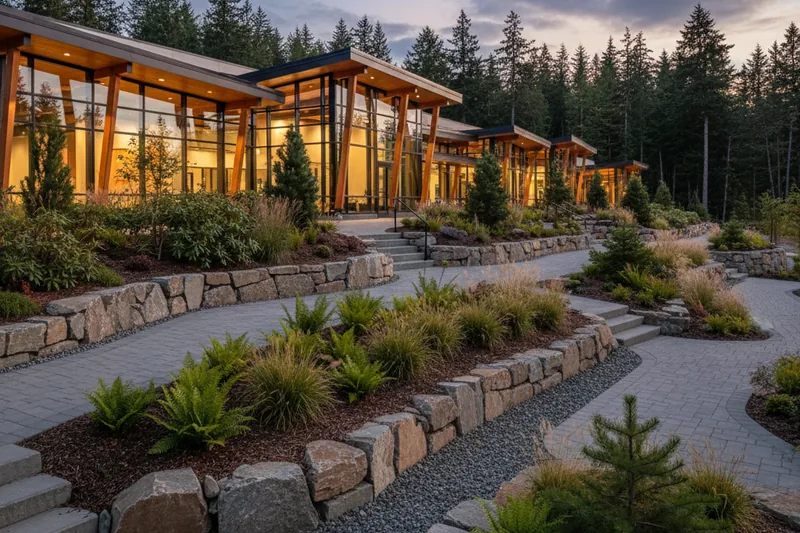
Commercial Hardscaping: Durability and Compliance for Business Owners
For a business owner, a retaining wall or a parking lot expansion isn’t just a landscaping choice; it is a structural asset that directly impacts liability, property value, and operational flow. Unlike residential projects, commercial hardscaping must meet more rigorous engineering standards and strict legal compliance codes to protect the public and the business’s bottom line.
The primary goal of commercial hardscaping is to create a landscape that is virtually maintenance-free while ensuring the safety of employees and customers. Whether you are managing a retail storefront in Seattle or an industrial warehouse in Everett, the durability of your retaining walls seattle and paved surfaces determines your long-term return on investment (ROI).
What is Commercial Hardscaping?
In plain English, commercial hardscaping refers to the “hard” or permanent structural elements of a business property’s exterior. This includes commercial retaining walls, heavy-duty walkways, loading dock areas, and industrial-grade drainage systems.
While residential hardscaping often focuses on aesthetics, industrial hardscaping prioritizes structural integrity. These features are designed to handle “surcharge loads”—the massive weight of delivery trucks, employee parking, or heavy equipment—without shifting, cracking, or failing.
Why Durability is the Only Metric That Matters
For a business, a hardscape failure is a liability nightmare. If a wall leans over a public sidewalk or a patio surface becomes uneven, it creates a trip-and-fall hazard that can lead to expensive litigation.
The True Cost of “Cheap” Construction
Choosing a low-bid contractor who cuts corners on base compaction or drainage may save 15% upfront, but it often leads to failure within 3 to 5 years. In a commercial setting, the cost of repairing a failed wall while keeping the business open is often triple the cost of the original installation.
Structural Redundancy
Professional commercial hardscaping uses “over-engineering.” This means the footings are deeper, the drainage pipes are larger, and the geogrid (soil reinforcement) extends further into the hillside than what is legally required. This redundancy ensures that even during record-breaking Washington rainstorms, your property remains stable.
Navigating Commercial Compliance and Permits
In Washington State, commercial projects are held to a higher standard than residential ones. You cannot simply “stack rocks” on a commercial site without significant oversight.
Americans with Disabilities Act (ADA) Compliance
Every walkway, ramp, and patio on a business property must adhere to strict ADA slope and width requirements. A commercial hardscaper must ensure that paving stones or concrete surfaces are perfectly level to prevent obstacles for wheelchairs and those with mobility aids.
Washington State Building Codes
Almost every commercial retaining wall over 4 feet tall requires a structural permit and a stamp from a licensed structural engineer. Furthermore, if your business is located near a shoreline or a critical slope, you may need to navigate additional environmental reviews to ensure your project doesn’t impact local water quality.
Comparing Commercial Material Options
Business owners must choose materials that balance aesthetic appeal with industrial-grade strength.Large Block Gravity Walls
These are massive, interlocking concrete blocks often seen in industrial parks.
- Pros: Extremely fast to install; can hold back immense weight without geogrid.
- Cons: Industrial “Lego” look; not always suitable for high-end retail locations.
Structural Rockeries and Boulders
Natural granite or basalt boulders are the gold standard for the Pacific Northwest.
- Pros: Naturally self-draining; lasts 50+ years; blends into the landscape.
- Cons: Requires a large “footprint” (they take up more space than vertical walls).
Mortared Masonry
Used for seating walls and entryways where a “finished” look is required.
- Pros: High aesthetic value; reinforces branding.
- Cons: Prone to surface cracking if the ground shifts; higher maintenance than dry-set stone.
The Industrial Hardscaping Process
A commercial project follows a strict timeline to minimize disruption to your business operations.1. Pre-Construction and Engineering (4–8 Weeks)
This phase involves soil testing (borings), structural engineering, and city permit reviews. We identify underground utilities and ensure the new structure won’t interfere with existing fire lines or electrical grids.
2. Mobilization and Site Preparation (1 Week)
Construction zones are fenced off to protect the public. Silt fences are installed to manage runoff, and heavy machinery is brought on-site.
3. Excavation and Soil Stabilization (1–2 Weeks)
The crew digs out the “bench” for the wall. In industrial settings, this often involves “over-excavating” to remove soft clay and replacing it with high-density structural fill.
4. Structural Build (Timeline varies)
The wall or patio is built in phases. Inspectors from the city visit the site to approve the footing, the drainage installation, and the final height.
Cost Factors for Business Owners
Commercial hardscaping is typically priced by the square foot of the wall face or the area of the paving. Several factors can drive these costs:
- Site Access: Can an excavator reach the wall easily, or do we need to move 500 tons of rock through a narrow alleyway?
- Soil Conditions: Saturated, “greasy” clay requires more intensive drainage and larger footings than stable, gravelly soil.
- Surcharge Loads: A wall holding up a parking lot for semi-trucks must be significantly more robust than a wall holding up a flower bed.
Common Mistakes in Business Landscaping
1. Inadequate Drainage
Water is the silent killer of retaining walls. Commercial sites often have large “impermeable surfaces” (roofs and parking lots) that dump thousands of gallons of water into the soil during a storm. If your wall doesn’t have a dedicated drainage system, that water will eventually push the wall over.
2. Ignoring Utility Easements
Many businesses have “easements” where the city or utility companies have the right to dig. Building a permanent stone wall over a main sewer line without permission can lead to the city forcing you to demolish the wall at your expense.
3. DIY “Maintenance”
Using salt or harsh chemicals to de-ice stone walkways can eat away at the mortar or cause natural stone to flake. Commercial properties should use magnesium chloride or other “stone-safe” de-icers to preserve their investment.
FAQs: What Business Owners Ask
How long will a commercial retaining wall last?
A properly engineered rockery or concrete block wall should last between 50 and 75 years. Most failures occur because of poor drainage, not because the materials themselves wore out.
Can we keep the business open during construction?
Yes. A professional contractor will create a “phased” construction plan that keeps entryways clear and minimizes noise during peak business hours.
Is hardscaping tax-deductible?
While this isn’t financial advice, most commercial hardscaping is considered a “land improvement” and can often be depreciated over 15 years. Repairs to existing structures are sometimes treated as immediate business expenses.
When This Solution is NOT a Good Fit
Hardscaping is a permanent structural solution. It is not the right choice if:
- You are planning to move your business location within the next 24 months.
- The soil is actively sliding (this requires deep-soil pinning or geotechnical “nails,” not just a wall).
- You have a limited budget that doesn’t allow for required city permits and engineering.
Written by
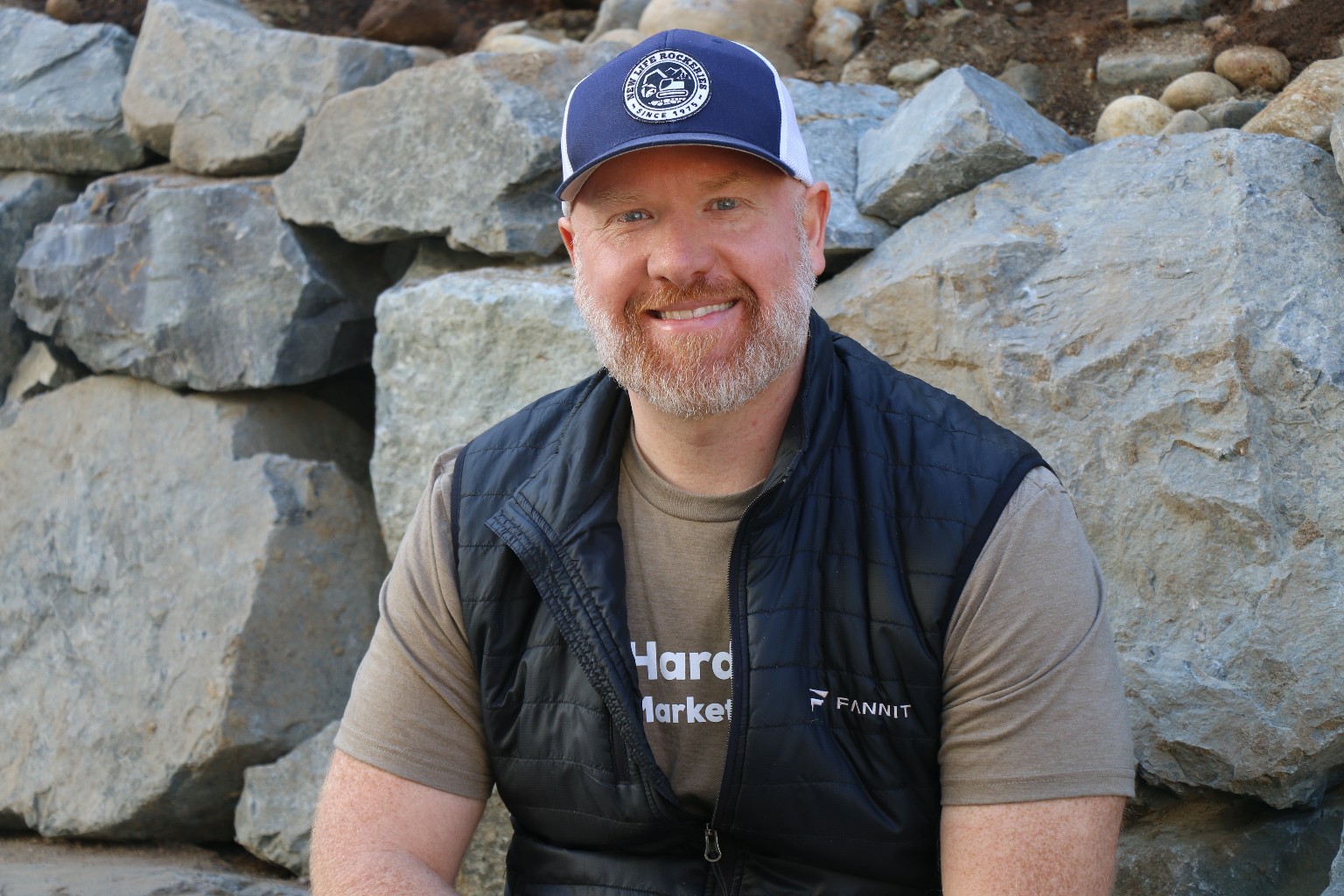
Keith EneixCo-Owner, New Life Rockeries
Keith Eneix is a co-owner of New Life Rockeries alongside his brother Neil Eneix. He began helping with operations in 2007 and has been involved ever since. He writes from nearly two decades of hands-on experience with retaining walls, rockeries, and hardscaping across the greater Seattle area.
View full profile →Ready to Start Your Project?
New Life Rockeries has been building retaining walls, rockeries, and hardscaping across the greater Seattle area since 1975. Get your free estimate today.