
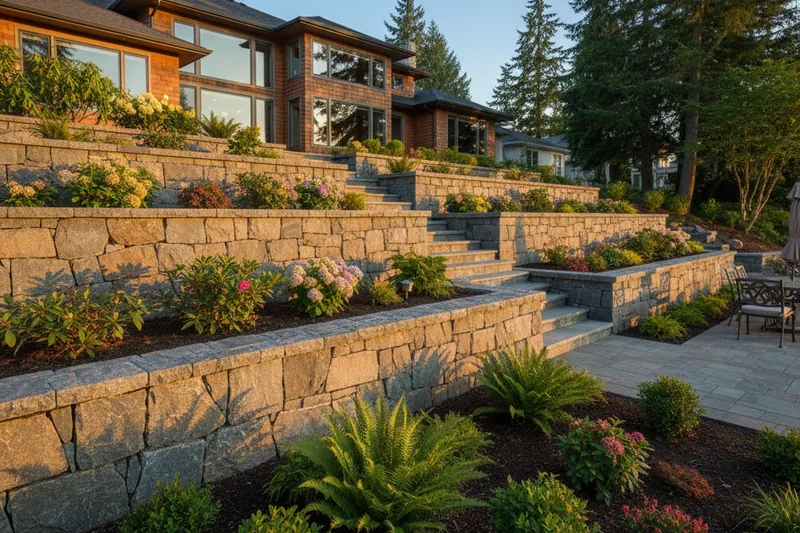
Seattle's Soil, Rain & Slopes: What Every Homeowner Needs to Know Before Building a Retaining Wall
When you hire a retaining wall contractor in Seattle homeowners must account for the unique geological and meteorological conditions of the Pacific Northwest. Based on over 50 years of local site evaluations and more than 2,100 completed landscape construction projects across King and Snohomish counties, we have documented exactly how these local conditions impact structural integrity. Seattle receives an average of 37 to 38 inches of rainfall annually, with the vast majority falling between October and April. This heavy seasonal precipitation creates massive hydrostatic pressure against structural barriers. Furthermore, the region is shaped by prehistoric glacial activity, leaving behind dense soil layers that dictate how water moves through your property. This guide provides exact specifications, permit thresholds, and diagnostic rules for installing, designing, and repairing retaining walls in the Seattle metro area.
Do I Need a Permit for a Retaining Wall in Seattle?
The Seattle Department of Construction and Inspections (SDCI) has strict, quantifiable rules regarding structural landscaping. Not every project requires city approval, but violating the building code can result in stop-work orders and double permit fees.
- The 4-Foot Rule: You do not need a construction permit if your retaining wall or rockery is 4 feet or lower in height. This measurement is taken from the very bottom of the footing, including the buried portion beneath the soil, to the top of the wall.
- Environmentally Critical Areas (ECAs): If your property is located in an ECA, such as a steep slope defined as a 40 percent grade or greater, a wetland, or a landslide-prone zone, you cannot build a retaining wall of any height without a permit or a specific exemption.
- Proximity to Property Lines: Building a wall directly on or immediately adjacent to a property line or public right-of-way typically triggers the need for a construction permit due to the potential for damage to neighboring land.
- Combined Fence and Wall Height: Seattle zoning laws state that if you place a fence on top of a retaining wall, the combined height cannot exceed 8 feet from the lower grade without special approval. If the wall is explicitly used to raise the grade of the property, the combined height limit is 9.5 feet.
For exact zoning requirements, property owners should consult the SDCI Retaining Walls and Rockeries portal.
Seattle Soil Conditions and Retaining Wall Design
A competent seattle retaining wall contractor must design structures based on the specific soil stratigraphy of the site. The Puget Sound region is dominated by glacial soils deposited during the Vashon Stade of the Fraser Glaciation approximately 15,000 years ago. In our experience excavating over 210,000 square feet of rockery foundation, we consistently encounter three primary soil profiles that dictate wall engineering.
- Vashon Glacial Till: Commonly referred to as hardpan, this is a highly consolidated mixture of boulders, cobbles, gravel, sand, and silt. Glacial till possesses high structural strength and provides excellent bearing capacity for foundations. However, it has extremely low permeability. Water does not drain easily through glacial till. When water gets trapped behind a retaining wall built on till, the hydrostatic pressure multiplies rapidly.
- Everett Gravelly Sandy Loam: Found on glacial outwash plains, this soil type is sandy, gravelly, and excessively drained. Retaining walls built in Everett soil areas handle water better but require careful compaction during installation to prevent settling.
- Seattle Muck: Found in valleys and depressions, this organic soil is very poorly drained and highly compressible. Building a structural wall over Seattle muck requires deep excavation to reach a stable load-bearing layer.
According to the Washington Soil Atlas, understanding these soil profiles is mandatory for calculating the equivalent fluid density and passive resistance necessary for engineering a stable wall.
Types of Retaining Walls Best Suited for the Pacific Northwest
Different materials offer distinct load-bearing capacities and lifespans when exposed to continuous Seattle wet weather.
Natural Stone Rockeries
rockery contractors use large, interlocking boulders ranging from 1-man to 4-man rocks to stabilize slopes.
- Lifespan: When built with proper drainage, a stone rockery can last indefinitely. Many Seattle rockeries built over 100 years ago are still fully functional today.
- Permeability: The natural gaps between the boulders allow water to weep through, reducing hydrostatic pressure naturally.
- Best Use: Stabilizing large hillsides and creating terraced garden beds in residential yards.
Concrete Block Retaining Walls
Segmental block walls use interlocking concrete units. They rely on their weight and the mechanical interlock of the blocks to hold back the earth. From analyzing hundreds of retaining walls seattle properties rely on, we note that block walls require the most rigorous backfill engineering to prevent hydrostatic blowout.
- Lifespan: Typically 50 to 100 years.
- Permeability: Blocks are solid, requiring a dedicated, engineered drainage system behind the wall to prevent failure.
- Best Use: hardscaping contractors, tight property lines, and areas requiring precise vertical space optimization.
Wood Timber Walls
Treated wood is sometimes used for small garden walls.
- Lifespan: 15 to 20 years maximum in Seattle. The constant winter moisture accelerates rot.
- Permeability: Poor. The wood expands and contracts with moisture.
- Best Use: Temporary or low-budget landscaping under 2 feet tall.
Installation Guidelines: The Engineering Rules
Proper installation prevents the most common causes of wall failure. In our 50 years of managing Pacific Northwest terrain, we have found that 80 percent of block wall failures are due to improper backfill drainage rather than material defects. Experienced retaining wall contractors seattle residents hire will adhere to the following strict dimensional and material rules.
- Base Trench Depth: The base trench must be dug deep enough to bury the first course of the wall. The industry standard is to bury 1 inch of the wall for every 1 foot of total wall height. This prevents the base from blowing out under pressure.
- Base Material: The foundation must consist of 4 to 6 inches of compacted, crushed gravel. Round river rock must never be used for a base because it shifts and rolls under weight.
- Backfill Requirements: The zone immediately behind the wall must be filled with at least 12 inches of clean, crushed angular gravel, typically 5/8 inch minus. This gravel column acts as a primary drainage channel.
- Perforated Drainage Pipe: A 4-inch perforated PVC or corrugated drain pipe must be installed at the base of the gravel backfill. This pipe captures the water that drops through the gravel and carries it away from the wall to a designated municipal storm drain or safe runoff zone. The pipe must be wrapped in a filter fabric to prevent silt from clogging the system.
- Geogrid Reinforcement: For block walls taller than 3 to 4 feet, lateral layers of geogrid mesh must be tied into the blocks and extended back into the compacted soil. This binds the soil and the wall together into one cohesive mass.
Signs Your Seattle Retaining Wall Needs Immediate Repair
Homeowners often wait too long to address structural landscaping failures. If you observe the following quantifiable metrics, you need a retaining wall repair evaluation immediately.
Diagnostic Metric Warning Sign Action Required Plumb Deviation The wall is leaning forward more than 2 inches from its original vertical axis. Immediate structural assessment. The soil weight has overcome the wall’s passive resistance. Crack Width Horizontal or stair-step cracks in block walls wider than 1/4 inch. Monitor for expansion. If widening, the foundation is settling unevenly.Bowing
A localized bulge protruding more than 1 inch in the center of the wall. Indicates a clogged drainage pipe directly behind the bulge causing concentrated hydrostatic pressure. Weep Hole Output No water exiting the weep holes or drainage pipe after 24 hours of continuous rain. The drainage system is blocked by silt. The wall must be excavated from behind to replace the pipe. Soil Sinkage The ground directly behind the wall has sunk more than 2 inches. The backfill soil is washing out through the wall. Filter fabric may have failed.According to the USGS Landslide Hazard program, heavy rainfall combined with compromised slope structures is the leading cause of shallow landslides in the region. Addressing these warning signs promptly prevents catastrophic property damage.
Cost Factors for Retaining Walls in Seattle
When budgeting for retaining walls seattle property owners should understand the variables that drive the total project cost. Through thousands of site consultations, we have identified four primary cost drivers.
- Site Access: Seattle is known for tightly packed neighborhoods and steep, narrow driveways. If the construction area can only be accessed by wheelbarrow rather than a mini-excavator, labor costs will increase significantly.
- Soil Export: Excavating a hillside generates massive volumes of dirt. If the native soil is Vashon glacial till, it cannot be reused as drainage backfill. The cost to load, haul, and pay dumping fees for this dirt at a local facility is a major line item.
- Material Selection: Natural 2-man or 3-man rockery boulders are generally more cost-effective per square foot than high-end architectural concrete blocks, though block walls require less heavy machinery to place.
- Permitting and Engineering: If the wall exceeds the 4-foot SDCI threshold, the project will require stamped drawings from a geotechnical or structural engineer, adding consulting and permit fees to the base construction cost.
Choosing the Right Contractor
A successful retaining wall project requires exact engineering, localized soil knowledge, and precise heavy machinery operation. You need a team that understands the difference between recessional outwash and glacial till, and how 37 inches of annual rain will interact with your specific property lines.
By following strict base preparation rules, utilizing proper angular gravel for backfill, and installing robust drainage solutions, a properly built wall will outlast the home it protects. If you are experiencing structural shifting or need a new installation, engaging a licensed professional early in the design phase ensures your project complies with all local building codes and environmental critical area regulations.
If you are evaluating your property for a new structural boundary or need to repair an existing slope, reaching out to a local professional is the best first step. As a rockeries expert serving the Pacific Northwest for over 50 years, New Life Rockeries can provide a detailed on-site consultation to analyze your soil, measure your grade, and build a lasting solution.
Ready to Start Your Project?
New Life Rockeries has been building retaining walls, rockeries, and hardscaping across the greater Seattle area since 1975. Get your free estimate today.
Get Your Free Estimate →
Written by
Keith EneixCo-Owner, New Life Rockeries
Keith Eneix is a co-owner of New Life Rockeries alongside his brother Neil Eneix. He began helping with operations in 2007 and has been involved ever since. He writes from nearly two decades of hands-on experience with retaining walls, rockeries, and hardscaping across the greater Seattle area.
View full profile →Ready to Start Your Project?
New Life Rockeries has been building retaining walls, rockeries, and hardscaping across the greater Seattle area since 1975. Get your free estimate today.