
Shoreline Solutions: A Guide to Lake Retaining Wall Repair & Maintenance
Shoreline Solutions: A Guide to Lake Retaining Wall Repair & Maintenance
A lake retaining wall is the only thing standing between your usable property and the relentless force of water. When these structures begin to fail, the result is more than just an eyesore; it is the active loss of your land through shoreline erosion.
The most critical thing to understand about lake retaining wall in Seattle repair is that water works from both sides. While waves hit the front, saturated soil creates massive pressure from behind. Successful repair or maintenance must address both to be permanent.
What is a Lake Retaining Wall?
In plain English, a lake retaining wall (often called a bulkhead or seawall) is a vertical or sloped barrier designed to prevent the lake from eating away at your yard. Unlike a standard backyard wall, these must withstand constant moisture, fluctuating water levels, and the hydraulic pressure of saturated earth.
Shoreline erosion control is the primary goal. Without a functional wall, the natural “slumping” of a shoreline will eventually move your property line backward, threatening docks, trees, and even home foundations.
How Waterfront Wall Repair Works
Repairing a wall in a lake environment is significantly more complex than standard masonry because you are often working in or near a delicate ecosystem.
The Inspection Phase
Before a single stone is moved, we identify the root cause of failure. Are there cracks caused by the freeze-thaw cycle? Is the wall bowing because water can’t drain out from behind it? Or is the “toe” (the bottom of the wall) being undermined by wave action?
The Stabilization Process
Tie-back Installation: Anchoring the wall into the stable soil further back in your yard.
Grout Injection: Filling voids behind the wall where soil has washed away.
Rip-Rap Addition: Placing large, heavy stones at the base of the wall to break the energy of incoming waves.
Common Signs Your Lake Wall Needs Repair
You should inspect your shoreline at least twice a year—once after the spring thaw and once before the winter freeze. Look for these red flags:
Sinkholes: If you notice small holes in the grass behind the wall, soil is likely escaping through a crack or gap below the water line.
Leaning or Bowing: If the top of the wall is tilting toward the lake, the internal anchors (deadmen) have likely failed.
Horizontal Cracking: This usually indicates that the pressure from saturated soil behind the wall is more than the structure can bear.
Outward Movement at the Base: Known as “kick-out,” this happens when the bottom of the wall loses its footing in the lakebed.
Materials: Comparing Shoreline Solutions
Not all materials are suited for every lakefront. Your choice depends on the “energy” of the lake (how big the waves get) and your local soil type
Rockeries and Boulders
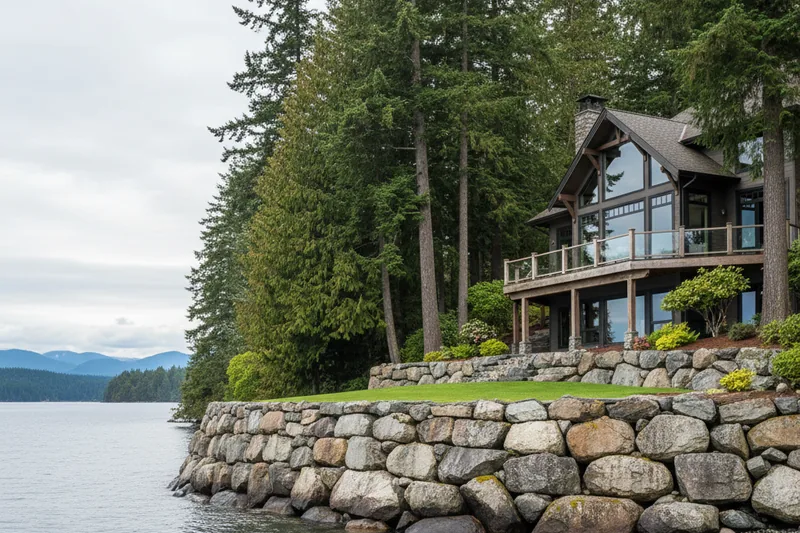
Natural boulders are the gold standard for Pacific Northwest lakes. They are heavy enough to stay in place and have natural gaps that allow water to recede without building up pressure.
Pros: Extremely durable, blends with the environment, handles soil movement well.
Cons: Requires heavy machinery for installation.
Concrete and Masonry
These provide a clean, formal look and are often used in high-traffic dock areas.
Pros: Creates a flat, usable surface; very strong.
Cons: Prone to cracking if the ground shifts; requires intensive drainage (weep holes).
Timber Bulkheads
Usually made from pressure-treated wood or “marine-grade” lumber.
Pros: Initially lower cost; easier to install in tight spaces.
Cons: Shorter lifespan than stone or concrete; susceptible to rot over decades.
Costs and Pricing Factors
Lake retaining wall repair is generally 20% to 50% more expensive than standard upland wall repair due to the environmental and logistical challenges.
Accessibility
If a contractor can’t get an excavator to the shoreline from your yard, they may need to bring in a barge. Barge-access work significantly increases the project cost due to transport and specialized equipment.
Permitting and Environmental Compliance
Shorelines are highly regulated. In Washington State, you often need permits from local municipalities and potentially the Department of Fish and Wildlife. Professional contractors include the time and cost of navigating these regulations in their quotes.
Depth of Failure
Replacing a few stones on the surface is a minor expense. However, if the “toe” of the wall has eroded, the entire base must be excavated and rebuilt, which is a major structural undertaking.
Timeline Expectations
This is the longest phase. Depending on the lake and the scope of work, environmental reviews can take time.Site Prep (2-3 Days): Moving equipment into place and installing silt fences to protect the lake’s water quality.
Active Repair (1-2 Weeks): The actual construction move quite fast once the materials are on-site.
Restoration (2-4 Days): Re-grading the soil behind the wall and planting erosion-resistant vegetation.
Common Mistakes in Shoreline Maintenance
1. Blocking Drainage
Many homeowners try to “fix” a leaking wall by plugging the gaps with concrete. This is a mistake. Water must be able to get out from behind the wall. If you plug the drainage, the weight of the water will eventually push the entire wall over.
2. Ignoring the “Toe”
If waves wash away the sand or silt at the very bottom of your wall, the whole structure will eventually slide into the lake. Always ensure the base of your wall is protected by “rip-rap” or large armor stones.
3. Using Non-Marine Materials
Using standard landscaping blocks for a lake wall is a recipe for failure. These blocks are often too light and don’t have the interlocking strength required to withstand wave energy or ice heaving.
FAQs: What Homeowners Are Afraid to Ask
Do I have to lower the lake level to repair my wall? Not necessarily. While work is easier if the water is low, professional shoreline contractors use “cofferdams” or work during seasonal low-water periods to perform repairs below the typical water line.
Will my homeowners’ insurance cover the repair? Standard policies rarely cover shoreline erosion or retaining wall failure unless it was caused by a specific, covered “peril” like a falling tree. Maintenance and erosion control are generally considered the owner’s responsibility.
Can I just throw more rocks over the edge? Adding “dumped rock” can help temporarily, but without a structural foundation or filter fabric, those rocks will eventually sink into the soft lakebed mud and disappear.
When This Solution is NOT a Good Fit
Repair is not always the answer. You should consider a full replacement or a different approach if:
The Wall is Over 50% Failed: At this point, the labor cost of “patching” exceeds the value of a new, warrantied structure.
Extreme Bank Instability: If the entire hillside is sliding, a retaining wall is just a “band-aid.” You may need deep-soil pinning or a geo-technical engineer.
Strict “Green Shoreline” Mandates: Some areas now require “soft armoring” (using logs and plants) rather than hard walls. In these cases, a traditional rock or concrete repair will not be permitted.
Ready to Start Your Project?
New Life Rockeries has been building retaining walls, rockeries, and hardscaping across the greater Seattle area since 1975. Get your free estimate today.
Get Your Free Estimate →
Written by
Keith EneixCo-Owner, New Life Rockeries
Keith Eneix is a co-owner of New Life Rockeries alongside his brother Neil Eneix. He began helping with operations in 2007 and has been involved ever since. He writes from nearly two decades of hands-on experience with retaining walls, rockeries, and hardscaping across the greater Seattle area.
View full profile →Ready to Start Your Project?
New Life Rockeries has been building retaining walls, rockeries, and hardscaping across the greater Seattle area since 1975. Get your free estimate today.