
Taming the Slope: Best Retaining Wall Designs for Steep Backyards

Taming the Slope: Best Retaining Wall Designs for Steep Backyards

Request a Quote

Taming the Slope: Best Retaining Wall Designs for Steep Backyards

Managing a steep backyard is often less about aesthetics and more about structural necessity. In areas like the Pacific Northwest, where hillsides and significant rainfall are common, an unmanaged slope can lead to rapid erosion, property damage, or unusable land.

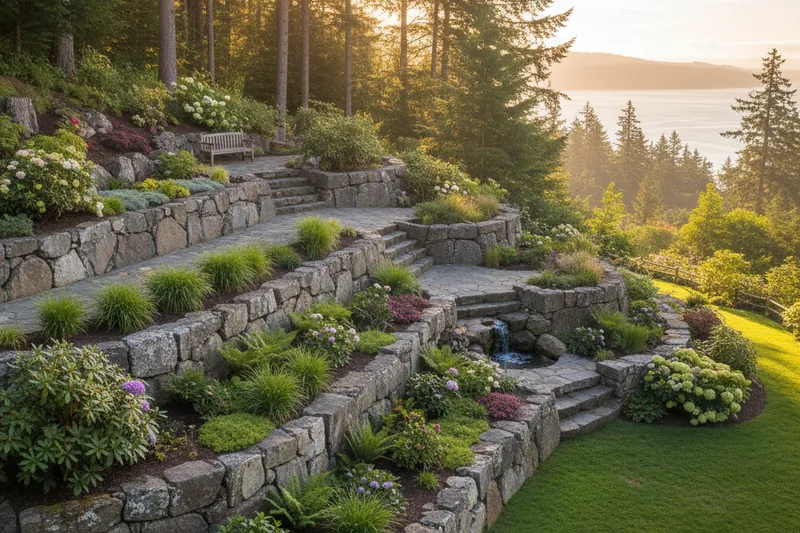
The best retaining wall design for a steep slope is typically terracing, which breaks one massive hill into several smaller, manageable levels. For slopes steeper than 45 degrees, heavy-duty structural solutions like gravity walls or anchored systems are required to handle the extreme soil pressure.

This guide breaks down the professional designs, materials, and costs you need to transform a dangerous incline into functional, high-value space.

Top Retaining Wall Designs for Steep Terrain

Choosing a design for a steep backyard depends on the “angle of repose”—the steepest angle at which soil remains stable without sliding.

Terraced Gardens (Multi-Level Walls

Terracing is the gold standard for steep slopes. Instead of building one massive 10-foot wall, you build a series of smaller 3-to-4-foot walls stepped up the hillside.

  • Safety: Smaller walls distribute the weight of the earth more evenly, reducing the risk of a catastrophic blowout.

  • Usability: Each level creates a flat “landing” that can be used for planting, patios, or pathways.

  • Permitting: In many municipalities, walls under 4 feet do not require a structural engineer, potentially saving thousands in permit fees.

Gravity Retaining Walls

Gravity walls rely purely on their own mass to hold the soil in place. They are typically thick and heavy at the base, often leaning back into the slope (a technique called “batter”).

  • Materials: Large boulders, heavy concrete blocks, or mortared stone are common.

  • Suitability: Best for moderate slopes where there is enough room for a wide base.

Anchored and Cantilever Walls

For extreme verticality or sites with limited space, anchored walls use cables or “tie-backs” driven deep into the hillside to provide stability. Cantilever walls use a reinforced concrete “L” or “T” shaped foundation to leverage the weight of the soil against itself.

Selecting the Best Materials for Steep Slopes

Material

Durability

Best For

Average Cost (per sq. ft.)

Interlocking Concrete Blocks

Very High

Most residential slopes

$20 – $55

Natural Stone / Boulders

Very High

Premium aesthetics; Rockeries

$20 – $100

Gabion Baskets

High

Excellent drainage; Modern look

$10 – $55

Pressure-Treated Timber

Moderate

Low-budget; Low heights

$15 – $30

Material selection is the biggest driver of both long-term durability and upfront cost.

Interlocking Concrete Blocks

These are the most popular choice for modern retaining wall material. They are engineered to fit together like Lego pieces, and their uniform shape makes them ideal for steep, structural applications where precision is mandatory.

Natural Stone and Boulders

Natural stone offers a timeless look but requires specialized equipment for installation. If you are looking to build a rock garden on a slope, large boulders provide the weight needed to act as a gravity wall while allowing for natural drainage through the gaps.

Gabion Walls

Gabion walls consist of wire cages filled with crushed rock. They are highly effective for steep slopes because they are porous, meaning water can flow through them effortlessly, preventing the buildup of “hydrostatic pressure” which is the #1 cause of retaining wall failure.

Understanding the Construction Process and Timeline

A professional retaining wall contractor follows a strict sequence to ensure the wall doesn’t move after the first heavy rain.

  1. Site Assessment (1-2 Days): Evaluating soil type (clay vs. sand) and checking for underground utilities by calling 811.

  2. Excavation and Footing (2-4 Days): Digging a trench at least 8-12 inches deep and filling it with 4-6 inches of compacted gravel to create a non-shifting foundation.

  3. Laying the First Course: This is the most critical step. The bottom layer must be perfectly level and partially buried to anchor the structure.

  4. Drainage and Backfill: A perforated pipe is placed at the base, and “clean” gravel is poured behind the wall. Each layer of backfill is mechanically compacted to prevent settling.

  5. Capping and Finishing: The final layer is glued or secured, and the surrounding landscape is restored.

Total Timeline: A standard 50-foot residential wall typically takes 3 to 7 days of active labor. Large engineered projects can take 2 to 4 weeks.

Costs and Pricing Factors for Steep Backyard Walls

Building on a slope is more expensive than building on flat land due to the increased labor and reinforcement required.

  • Average Cost: Most homeowners pay between $3,500 and $9,600 for a standard retaining wall in 2026.

  • Linear Foot Pricing: Expect to spend $40 to $360 per linear foot depending on the height and material.

  • The “Slope Premium”: You should budget an extra 20% to 30% for excavation and grading if your backyard is particularly steep.

  • Permit and Engineering Fees: If the wall is over 4 feet, a structural engineer must design it, which usually costs $350 to $750, plus permit fees ranging from $50 to $450.

To get a better sense of local PNW pricing, check our detailed guide on how much a retaining wall costs in Seattle.

Common Mistakes and How to Avoid Them

Even expensive walls will collapse if basic engineering principles are ignored.

  • Ignoring Drainage: Water is the “wall killer.” Without a perforated pipe and gravel backfill, water weight (hydrostatic pressure) will eventually push the wall over.

  • Inadequate Footing: If the base isn’t deep enough or is built on soft soil, the wall will eventually sink or lean.

  • Wrong Material Choice: Using a railroad tie retaining wall on a high-moisture slope is risky, as timber will eventually rot.

  • Ignoring the Surcharge: A “surcharge” is any extra weight near the wall, such as a driveway, a shed, or another wall. If you don’t account for this extra pressure, the wall will fail.

When a Retaining Wall Isn’t the Right Solution

A retaining wall is a powerful tool, but it’s not always the best fit.

  • Deep Landslide Risks: If the entire hillside is fundamentally unstable, a retaining wall is just a bandage. You may need “soil nailing” or deep geotechnical anchors.

  • Natural Water Swales: If your wall blocks a natural path where water flows during heavy storms, you could cause flooding in your home or your neighbor’s yard.

  • Limited Access: If a crew cannot get an excavator or material hauler into the backyard, the labor cost for hand-carrying stones may become prohibitive.

In these cases, planting deep-rooted shrubs and using erosion control blankets might be a more cost-effective way to manage a mild slope.

Frequently Asked Questions

Do I need a permit for my retaining wall?

In most Washington municipalities, including Lynnwood, you need a permit if the wall is over 4 feet tall or if it supports a surcharge (like a driveway). Always check your local building codes before starting.

Why do I see cracks in my existing wall?

Retaining wall cracks are usually signs of shifting soil or poor drainage. If the cracks are vertical and expanding, the wall may be reaching a point of structural failure and needs professional inspection.

Can I build this wall myself?

DIY is feasible for small garden walls under 3 feet. However, for steep backyards where the wall is structural, hiring a professional ensures the wall is built to handle the extreme soil loads and seismic activity common in the PNW.

Request a Quote

Managing a steep backyard is often less about aesthetics and more about structural necessity. In areas like the Pacific Northwest, where hillsides and significant rainfall are common, an unmanaged slope can lead to rapid erosion, property damage, or unusable land.

The best retaining wall design for a steep slope is typically terracing, which breaks one massive hill into several smaller, manageable levels. For slopes steeper than 45 degrees, heavy-duty structural solutions like gravity walls or anchored systems are required to handle the extreme soil pressure.

This guide breaks down the professional designs, materials, and costs you need to transform a dangerous incline into functional, high-value space.

Top Retaining Wall Designs for Steep Terrain

Choosing a design for a steep backyard depends on the “angle of repose”—the steepest angle at which soil remains stable without sliding.

Terraced Gardens (Multi-Level Walls

Terracing is the gold standard for steep slopes. Instead of building one massive 10-foot wall, you build a series of smaller 3-to-4-foot walls stepped up the hillside.

  • Safety: Smaller walls distribute the weight of the earth more evenly, reducing the risk of a catastrophic blowout.

  • Usability: Each level creates a flat “landing” that can be used for planting, patios, or pathways.

  • Permitting: In many municipalities, walls under 4 feet do not require a structural engineer, potentially saving thousands in permit fees.

Gravity Retaining Walls

Gravity walls rely purely on their own mass to hold the soil in place. They are typically thick and heavy at the base, often leaning back into the slope (a technique called “batter”).

  • Materials: Large boulders, heavy concrete blocks, or mortared stone are common.

  • Suitability: Best for moderate slopes where there is enough room for a wide base.

Anchored and Cantilever Walls

For extreme verticality or sites with limited space, anchored walls use cables or “tie-backs” driven deep into the hillside to provide stability. Cantilever walls use a reinforced concrete “L” or “T” shaped foundation to leverage the weight of the soil against itself.

Selecting the Best Materials for Steep Slopes

Material

Durability

Best For

Average Cost (per sq. ft.)

Interlocking Concrete Blocks

Very High

Most residential slopes

$20 – $55

Natural Stone / Boulders

Very High

Premium aesthetics; Rockeries

$20 – $100

Gabion Baskets

High

Excellent drainage; Modern look

$10 – $55

Pressure-Treated Timber

Moderate

Low-budget; Low heights

$15 – $30

Material selection is the biggest driver of both long-term durability and upfront cost.

Interlocking Concrete Blocks

These are the most popular choice for modern retaining wall material. They are engineered to fit together like Lego pieces, and their uniform shape makes them ideal for steep, structural applications where precision is mandatory.

Natural Stone and Boulders

Natural stone offers a timeless look but requires specialized equipment for installation. If you are looking to build a rock garden on a slope, large boulders provide the weight needed to act as a gravity wall while allowing for natural drainage through the gaps.

Gabion Walls

Gabion walls consist of wire cages filled with crushed rock. They are highly effective for steep slopes because they are porous, meaning water can flow through them effortlessly, preventing the buildup of “hydrostatic pressure” which is the #1 cause of retaining wall failure.

Understanding the Construction Process and Timeline

A professional retaining wall contractor follows a strict sequence to ensure the wall doesn’t move after the first heavy rain.

  1. Site Assessment (1-2 Days): Evaluating soil type (clay vs. sand) and checking for underground utilities by calling 811.

  2. Excavation and Footing (2-4 Days): Digging a trench at least 8-12 inches deep and filling it with 4-6 inches of compacted gravel to create a non-shifting foundation.

  3. Laying the First Course: This is the most critical step. The bottom layer must be perfectly level and partially buried to anchor the structure.

  4. Drainage and Backfill: A perforated pipe is placed at the base, and “clean” gravel is poured behind the wall. Each layer of backfill is mechanically compacted to prevent settling.

  5. Capping and Finishing: The final layer is glued or secured, and the surrounding landscape is restored.

Total Timeline: A standard 50-foot residential wall typically takes 3 to 7 days of active labor. Large engineered projects can take 2 to 4 weeks.

Costs and Pricing Factors for Steep Backyard Walls

Building on a slope is more expensive than building on flat land due to the increased labor and reinforcement required.

  • Average Cost: Most homeowners pay between $3,500 and $9,600 for a standard retaining wall in 2026.

  • Linear Foot Pricing: Expect to spend $40 to $360 per linear foot depending on the height and material.

  • The “Slope Premium”: You should budget an extra 20% to 30% for excavation and grading if your backyard is particularly steep.

  • Permit and Engineering Fees: If the wall is over 4 feet, a structural engineer must design it, which usually costs $350 to $750, plus permit fees ranging from $50 to $450.

To get a better sense of local PNW pricing, check our detailed guide on how much a retaining wall costs in Seattle.

Common Mistakes and How to Avoid Them

Even expensive walls will collapse if basic engineering principles are ignored.

  • Ignoring Drainage: Water is the “wall killer.” Without a perforated pipe and gravel backfill, water weight (hydrostatic pressure) will eventually push the wall over.

  • Inadequate Footing: If the base isn’t deep enough or is built on soft soil, the wall will eventually sink or lean.

  • Wrong Material Choice: Using a railroad tie retaining wall on a high-moisture slope is risky, as timber will eventually rot.

  • Ignoring the Surcharge: A “surcharge” is any extra weight near the wall, such as a driveway, a shed, or another wall. If you don’t account for this extra pressure, the wall will fail.

When a Retaining Wall Isn’t the Right Solution

A retaining wall is a powerful tool, but it’s not always the best fit.

  • Deep Landslide Risks: If the entire hillside is fundamentally unstable, a retaining wall is just a bandage. You may need “soil nailing” or deep geotechnical anchors.

  • Natural Water Swales: If your wall blocks a natural path where water flows during heavy storms, you could cause flooding in your home or your neighbor’s yard.

  • Limited Access: If a crew cannot get an excavator or material hauler into the backyard, the labor cost for hand-carrying stones may become prohibitive.

In these cases, planting deep-rooted shrubs and using erosion control blankets might be a more cost-effective way to manage a mild slope.

Frequently Asked Questions

Do I need a permit for my retaining wall?

In most Washington municipalities, including Lynnwood, you need a permit if the wall is over 4 feet tall or if it supports a surcharge (like a driveway). Always check your local building codes before starting.

Why do I see cracks in my existing wall?

Retaining wall cracks are usually signs of shifting soil or poor drainage. If the cracks are vertical and expanding, the wall may be reaching a point of structural failure and needs professional inspection.

Can I build this wall myself?

DIY is feasible for small garden walls under 3 feet. However, for steep backyards where the wall is structural, hiring a professional ensures the wall is built to handle the extreme soil loads and seismic activity common in the PNW.