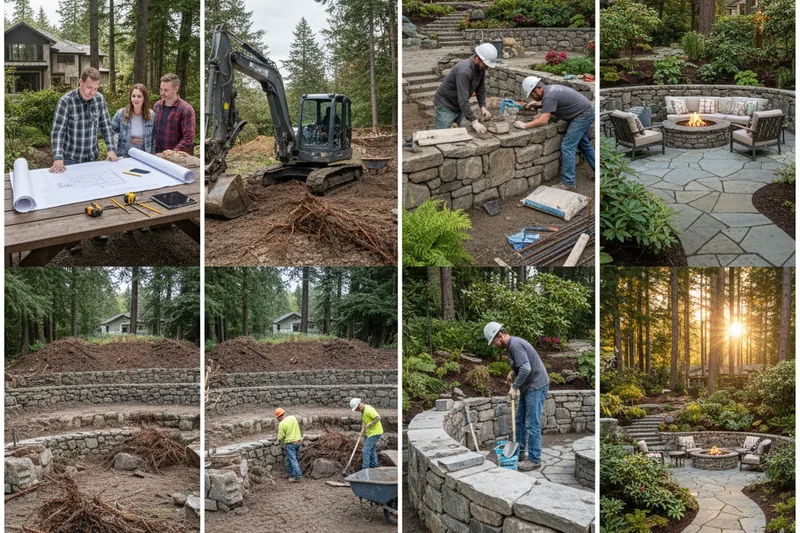
Phase 1: Initial Contact and Consultation (Week 1)
The journey begins when you reach out to a hardscape contractor. This initial phase is all about understanding your vision and the project’s feasibility.
The Initial Phone Call
During this call, the contractor gathers basic information: your location, project type (patio, retaining wall, etc.), and your desired timeline. This helps them determine if your project aligns with their expertise and availability.
On-Site Consultation
A crucial step where the contractor visits your property. They assess the site’s unique challenges and opportunities, discuss design ideas, and answer your questions. This is also when they take measurements and photos.
Phase 2: Design and Proposal (Weeks 2–4)
Once the contractor has a clear understanding of your needs, they move into the design and proposal phase.
Conceptual Design
Based on the consultation, the contractor creates a conceptual design. This might be a hand-drawn sketch or a more detailed computer-generated rendering, depending on the project’s complexity.
Detailed Proposal
The proposal outlines the scope of work, materials, timeline, and cost. It’s essential to review this document carefully and ask for clarifications if needed.
Phase 3: Permitting and Preparation (Weeks 5–9)
This phase often involves waiting, as permits and materials can take time to acquire.
Permit Acquisition
For larger projects, permits are often required. The contractor typically handles this process, but it can involve waiting for municipal approvals. This can be the longest part of the process, especially on lakefront properties.
The Bench and the Footing
The crew excavates a “bench”—a level area where the wall or patio will sit. For a retaining wall, they dig a trench for the footing. Depending on the design, this might be a compacted gravel base for a rockery or a deep concrete slab for a mortared wall.
Phase 4: Structural Construction (Weeks 10–11)
This is when the project takes visible shape. While this is the loudest phase, it is often the most rewarding for homeowners to watch.
How Long to Install a Paver Patio?
A standard 400-square-foot paver patio typically takes 3 to 5 days of active construction:
Day 1: Excavation and base preparation.
Day 2: Compacting gravel and laying the bedding sand.
Day 3–4: Laying the pavers and cutting edge pieces.
Day 5: Applying polymeric sand and final compaction.
Building the Wall
For retaining walls, the “batter”—or the slight backward lean toward the slope—is established in the first few courses of stone. Crews carefully lay each stone, ensuring there is a thick layer of clean, crushed gravel behind the wall for drainage solutions.
Phase 5: Drainage and Backfill (Week 11)
Water is the primary cause of hardscape failure. This phase is the most critical for the long-term survival of your investment.
Contractors install perforated drainage pipes (weep holes) and backfill the area behind the wall with stone. Using native soil or “dirt” as backfill is a common mistake; dirt holds water and becomes heavy mud that can push a wall over during a heavy rainstorm.
Phase 6: Clean-up and Restoration (Week 12)
The final week is about erasing the “scars” of construction.
Restoration: Re-grading the soil around the new structure and planting grass or shrubs.
Cleaning: Power-washing the stone surfaces to remove dust and mortar smears.
Final Walkthrough: You and the project manager inspect the work to ensure every detail matches the original design.
Factors That Delay Your Hardscape Project
Even the best-planned projects can face setbacks. Understanding these variables helps reduce stress when they occur.
Weather: Professional crews cannot lay mortar in heavy rain or compact a base if the ground is completely saturated.
Access Issues: If a site is “barge-access only” (common for lake retaining wall repairs), the timeline depends on barge availability and lake water levels.
Material Shortages: Special-order flagstone or unique paver colors can sometimes be backordered for weeks.
Permit Backlogs: Municipalities can sometimes take double the estimated time to review structural drawings during peak construction seasons.
FAQs: Common Timeline Questions
Can you build a hardscape project in the winter?
In the Pacific Northwest, we can build most of the year. However, projects involving poured concrete or mortar are difficult in freezing temperatures. Dry stack rockeries and paver patios are generally easier to install in the “off-season.”
Why does the quote take so long to get back to me?
A high-quality quote requires the contractor to call material yards for current pricing and potentially consult with an engineer. A “fast” quote is often an estimate that may change later; a detailed quote takes 3 to 7 days.
Will I have a giant hole in my yard for weeks?
Ideally, no. A professional contractor will coordinate the excavation so that the base material and stone arrive immediately after the hole is dug. However, if an inspector is required to check the footing, there may be a 24–48 hour pause.
When a Professional Timeline is NOT a Good Fit
If you are looking for a “weekend project,” professional hardscaping may not be for you. This solution is not a good fit if:
You need the project finished in less than 14 days from today.
You have a limited budget that doesn’t allow for the necessary permitting or engineering.
You prefer a “DIY” approach where you can change the design mid-build.
Professional hardscaping is a long-term investment. Taking the time to do the “invisible” phases correctly ensures the structure will last for 50 years rather than five.