
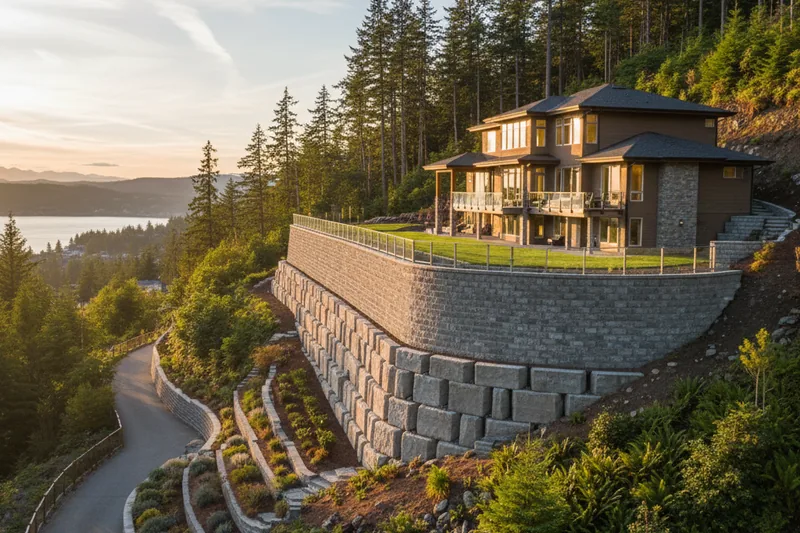
What Are Anchored Retaining Walls?
When a standard gravity wall or concrete block wall isn't strong enough to hold back a steep slope, anchored retaining walls offer a solution. They are used in situations where the wall needs to resist unusually high lateral pressure — such as tall slopes, heavy surcharge loads from structures above, or sites with poor soil conditions. Understanding how they work can help you make a more informed decision when planning your retaining wall project.
This is an educational guide explaining how this type of project works. If you need professional installation in the greater Seattle area, see our Anchored Retaining Walls service page for pricing, photos, and a free estimate.
What Makes a Retaining Wall "Anchored"?
An anchored retaining wall uses cables, rods, or helical anchors that are drilled or driven horizontally into the soil or rock behind the wall face. These tiebacks extend deep into stable ground and are tensioned to provide additional holding force beyond what the wall itself can provide through weight alone. The result is a wall that can handle significantly higher loads than a conventional gravity or block wall of the same height.
Tiebacks are typically installed at a 15–45 degree angle downward into the slope. Once inserted, they are grouted in place and tensioned against a bearing plate on the wall face. This creates a mechanical connection between the wall and the stable earth behind it.
When Are Anchored Retaining Walls Used?
Anchored walls are most commonly specified in the following situations:
- Tall walls over 10 feet: Gravity and block walls become impractical at significant heights. Anchoring allows taller walls to be built without requiring an enormous base width.
- Steep slopes with heavy surcharge: If there is a structure, driveway, or heavy load at the top of the slope, the lateral pressure on the wall increases substantially. Anchors compensate for this added force.
- Poor or loose soil conditions: In areas with soft, saturated, or unstable soils — common in parts of the Pacific Northwest — anchors provide the additional resistance needed for long-term stability.
- Limited space for wall base: On tight urban lots where there isn't room for a wide gravity wall base, anchors allow a slimmer wall profile.
How the Installation Process Works
The installation of an anchored retaining wall follows a logical sequence. First, the site is excavated and the wall face is constructed — this may be poured concrete, precast panels, or steel sheet piling depending on the design. Once the wall face is in place, holes are drilled through it at the specified angle and depth. The tieback anchors are inserted, grouted, and then tensioned using hydraulic jacks to the design load. Finally, the bearing plates are locked off and the excavation is backfilled with compacted gravel to ensure proper drainage.
Maintenance and Longevity
Properly installed anchored retaining walls are designed for a service life of 50 years or more. The anchors themselves are typically galvanized or epoxy-coated to resist corrosion. Routine inspection every few years is recommended to check for any signs of wall movement, drainage issues, or anchor head corrosion.
If you have a challenging slope or a wall project that exceeds standard height limits, New Life Rockeries can assess whether an anchored solution is right for your property. We serve homeowners and commercial clients across King, Snohomish, and Skagit counties. Learn more about our anchored retaining wall services or call 425-584-6878 for a free consultation.

Written by
Keith EneixCo-Owner, New Life Rockeries
Keith Eneix is a co-owner of New Life Rockeries alongside his brother Neil Eneix. He began helping with operations in 2007 and has been involved ever since. He writes from nearly two decades of hands-on experience with retaining walls, rockeries, and hardscaping across the greater Seattle area.
View full profile →Ready to Start Your Project?
New Life Rockeries has been building retaining walls, rockeries, and hardscaping across the greater Seattle area since 1975. Get your free estimate today.