
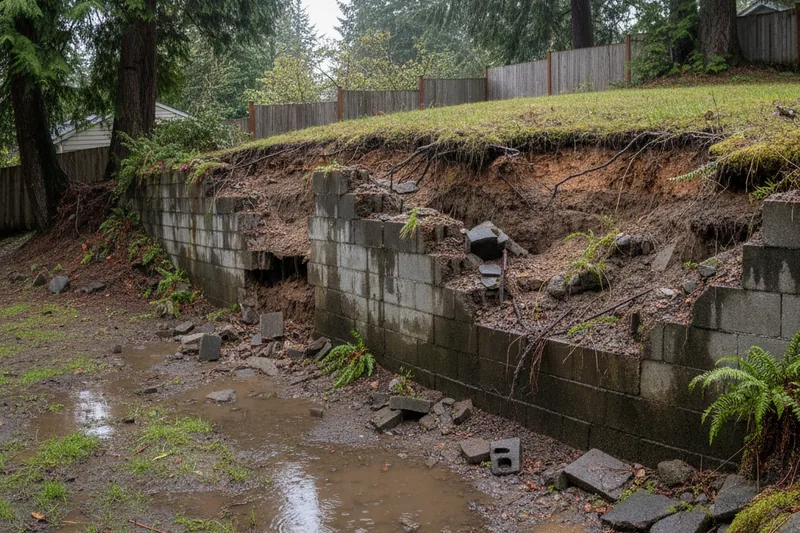
Why Retaining Walls Fail: The Importance of Drainage and Backfill

Why Retaining Walls Fail: The Importance of Drainage and Backfill

Request a Quote

Why Retaining Walls Fail: The Importance of Drainage and Backfill

A retaining wall is more than just a stack of stones or blocks used to level a yard. It is a structural engineering project designed to resist the massive lateral pressure of soil. When a wall fails, it is rarely due to the strength of the material itself. Instead, it is almost always due to what is happening behind and underneath the wall.

The most common reason retaining walls fail is poor water management and incorrect backfill. Without a way for water to escape, hydrostatic pressure builds up behind the wall, creating a force that even the heaviest concrete blocks cannot withstand.

If you are seeing retaining wall cracks, bulging, or leaning, your wall is likely failing due to these invisible forces. This guide explains why these failures happen and how to prevent them through proper drainage and backfill techniques.

What is a Retaining Wall? (The Plain English Definition)

In simple terms, a retaining wall is a structure that holds back a vertical or near-vertical face of earth. Without the wall, the soil would naturally slump into a slope. The wall creates a “cut” in the landscape, allowing for flat driveways, usable patios, or protected home foundations.

How It Works: The Battle Against Gravity

The soil behind a wall wants to move downward and outward. A successful wall works by being heavier and more stable than the soil it is holding. It relies on a combination of its own weight (mass) and reinforcements (like geogrid or anchors) to stay in place.

The Silent Killer: Hydrostatic Pressure

The number one enemy of a retaining wall is water. When it rains, the soil behind your wall absorbs water like a sponge. Saturated soil is significantly heavier than dry soil, and it exerts “hydrostatic pressure.”

If the water has no way to exit from behind the wall, that pressure builds until it exceeds the structural capacity of the wall. This leads to the wall “bowing” out in the center or leaning forward at the top. This is why professional retaining wall contractors focus as much on the plumbing of the wall as they do on the masonry.

The Core Components of a Fail-Safe Wall

To prevent failure, every structural wall needs three specific components: the right backfill, a drainage pipe, and a filter fabric.

1. The Backfill: Why Dirt is Dangerous

You should never backfill a retaining wall with the dirt you just dug out of the ground—especially in the Pacific Northwest, where clay-heavy soil is common. Clay expands when wet and holds onto water, maximizing the pressure on your wall.

Instead, the space immediately behind the wall (the “drainage column”) should be filled with clean, crushed aggregate. This gravel allows water to fall quickly to the bottom of the trench rather than pressing against the back of the blocks.

2. The Drainage Pipe (The Perforated Drain)

At the base of your gravel backfill, there should be a perforated drain pipe. This pipe collects the water that has filtered down through the aggregate and carries it safely away to a daylight exit or a storm drain. Without this pipe, water simply pools at the base of the wall, softening the soil and causing the wall to sink or “toe out.”

3. Geotextile Filter Fabric

Filter fabric is a synthetic mesh placed between the gravel backfill and the natural soil. Its job is to keep fine silt and dirt from migrating into your clean gravel. If dirt gets into your gravel, it will eventually clog the drainage system, leading back to the same hydrostatic pressure issues that cause retaining wall failure.

Common Mistakes That Lead to Collapse

Most failures are avoidable. If you are vetting a contractor or considering a DIY project, watch out for these critical errors:

  • Using the Wrong Gravel: “Pit run” or “pea gravel” is often too round and doesn’t lock together. Professional builds require angular, crushed stone.

  • Skipping the Bury Course: A wall should never sit on top of the grass. The first course of stone or block must be buried (usually 1 inch for every foot of wall height) to anchor the base.

  • Poor Compaction: Each layer of backfill must be compacted with a mechanical plate compactor. Simply walking on the gravel is not enough; air pockets will remain, leading to future settling.

  • Lack of Geogrid: For walls over 4 feet, “geogrid” (a high-strength mesh) must be laid between the blocks and extended back into the soil to tie the wall and the earth mass together.

Choosing the Right Approach: Comparisons

The type of wall you build affects how you manage drainage and backfill.

Wall Type
Common Use
Drainage Needs
Durability

Segmental Block

Residential Yards

High (Internal pipe)

Excellent

Natural Rockery

Steep Slopes

Moderate (Natural gaps)

High

Railroad Ties

Budget Projects

High (Critical)

Moderate (Rot risk)

Poured Concrete

Commercial/Heavy Load

Extreme (Weep holes)

Superior

While a railroad tie retaining wall is cost-effective, wood naturally holds moisture and will rot faster if the backfill doesn’t allow for rapid drainage.

Costs and Timeline Expectations

Investing in proper drainage and backfill adds to the upfront cost, but it saves you from a total rebuild in five years.

Pricing Factors

  • Material Hauling: Moving tons of dirt out and tons of gravel in is a major cost factor.

  • Engineering: Walls over 4 feet often require a structural engineer’s stamp in cities like Lynnwood or Seattle.

  • Access: If a contractor can’t get a machine to the back of the wall, hand-digging and hand-filling can double the labor costs.

For a detailed look at local pricing, refer to our guide on retaining wall costs in Seattle.

Timeline

A standard residential retaining wall (3 feet tall, 50 feet long) typically takes 3 to 5 days to complete, assuming the site is accessible. A significant portion of that time is spent digging the trench and leveling the base—not actually stacking the stones.

When a Retaining Wall is NOT a Good Fit

Not every slope needs a wall. You might consider an alternative solution if:

  1. The Slope is Too Steep for Mass: If the hillside is naturally unstable (a landslide risk), a standard wall won’t work. You may need “soil nailing” or deep-seated anchors.

  2. Poor Machine Access: If you cannot get gravel to the site, the wall is doomed to fail because you won’t be able to backfill it correctly.

  3. Natural Water Paths: If your wall blocks a major natural drainage swale, you will create a flood in your (or your neighbor’s) yard.

In these cases, a rockery on a slope might be a better, more permeable option.

FAQs People Are Afraid to Ask

Why does my wall have white fuzzy stuff on it?

That is called efflorescence. It is caused by water moving through the blocks and leaving salt minerals behind. While it’s mostly an aesthetic issue, it is a sign that water is lingering behind the wall too long.

Can I just drill holes in the wall to let water out?

These are called “weep holes.” They are common in concrete walls but are not a substitute for a proper drainage pipe at the base. If you only have weep holes, you will likely see staining and soil erosion coming through the holes.

Do I really need a permit for a 3-foot wall?

In most Washington jurisdictions, walls under 4 feet do not require a permit. However, if the wall is supporting a driveway or a house foundation (a “surcharge”), you need a permit regardless of height.

How to Choose the Right Provider

When interviewing contractors, ask them specifically about their backfill and drainage plan. If they tell you “we just use the dirt on-site,” end the conversation.

A reputable provider will talk about:

  • Compaction equipment (plate compactors).

  • The type of crushed aggregate they use.

  • Where the water will drain (the “daylight” point).

Managing tons of earth and rock is dangerous work. Knowing how to move large rocks and boulders is a specialized skill that requires the right equipment and experience.

Request a Quote

A retaining wall is more than just a stack of stones or blocks used to level a yard. It is a structural engineering project designed to resist the massive lateral pressure of soil. When a wall fails, it is rarely due to the strength of the material itself. Instead, it is almost always due to what is happening behind and underneath the wall.

The most common reason retaining walls fail is poor water management and incorrect backfill. Without a way for water to escape, hydrostatic pressure builds up behind the wall, creating a force that even the heaviest concrete blocks cannot withstand.

If you are seeing retaining wall cracks, bulging, or leaning, your wall is likely failing due to these invisible forces. This guide explains why these failures happen and how to prevent them through proper drainage and backfill techniques.

What is a Retaining Wall? (The Plain English Definition)

In simple terms, a retaining wall is a structure that holds back a vertical or near-vertical face of earth. Without the wall, the soil would naturally slump into a slope. The wall creates a “cut” in the landscape, allowing for flat driveways, usable patios, or protected home foundations.

How It Works: The Battle Against Gravity

The soil behind a wall wants to move downward and outward. A successful wall works by being heavier and more stable than the soil it is holding. It relies on a combination of its own weight (mass) and reinforcements (like geogrid or anchors) to stay in place.

The Silent Killer: Hydrostatic Pressure

The number one enemy of a retaining wall is water. When it rains, the soil behind your wall absorbs water like a sponge. Saturated soil is significantly heavier than dry soil, and it exerts “hydrostatic pressure.”

If the water has no way to exit from behind the wall, that pressure builds until it exceeds the structural capacity of the wall. This leads to the wall “bowing” out in the center or leaning forward at the top. This is why professional retaining wall contractors focus as much on the plumbing of the wall as they do on the masonry.

The Core Components of a Fail-Safe Wall

To prevent failure, every structural wall needs three specific components: the right backfill, a drainage pipe, and a filter fabric.

1. The Backfill: Why Dirt is Dangerous

You should never backfill a retaining wall with the dirt you just dug out of the ground—especially in the Pacific Northwest, where clay-heavy soil is common. Clay expands when wet and holds onto water, maximizing the pressure on your wall.

Instead, the space immediately behind the wall (the “drainage column”) should be filled with clean, crushed aggregate. This gravel allows water to fall quickly to the bottom of the trench rather than pressing against the back of the blocks.

2. The Drainage Pipe (The Perforated Drain)

At the base of your gravel backfill, there should be a perforated drain pipe. This pipe collects the water that has filtered down through the aggregate and carries it safely away to a daylight exit or a storm drain. Without this pipe, water simply pools at the base of the wall, softening the soil and causing the wall to sink or “toe out.”

3. Geotextile Filter Fabric

Filter fabric is a synthetic mesh placed between the gravel backfill and the natural soil. Its job is to keep fine silt and dirt from migrating into your clean gravel. If dirt gets into your gravel, it will eventually clog the drainage system, leading back to the same hydrostatic pressure issues that cause retaining wall failure.

Common Mistakes That Lead to Collapse

Most failures are avoidable. If you are vetting a contractor or considering a DIY project, watch out for these critical errors:

  • Using the Wrong Gravel: “Pit run” or “pea gravel” is often too round and doesn’t lock together. Professional builds require angular, crushed stone.

  • Skipping the Bury Course: A wall should never sit on top of the grass. The first course of stone or block must be buried (usually 1 inch for every foot of wall height) to anchor the base.

  • Poor Compaction: Each layer of backfill must be compacted with a mechanical plate compactor. Simply walking on the gravel is not enough; air pockets will remain, leading to future settling.

  • Lack of Geogrid: For walls over 4 feet, “geogrid” (a high-strength mesh) must be laid between the blocks and extended back into the soil to tie the wall and the earth mass together.

Choosing the Right Approach: Comparisons

The type of wall you build affects how you manage drainage and backfill.

Wall Type
Common Use
Drainage Needs
Durability

Segmental Block

Residential Yards

High (Internal pipe)

Excellent

Natural Rockery

Steep Slopes

Moderate (Natural gaps)

High

Railroad Ties

Budget Projects

High (Critical)

Moderate (Rot risk)

Poured Concrete

Commercial/Heavy Load

Extreme (Weep holes)

Superior

While a railroad tie retaining wall is cost-effective, wood naturally holds moisture and will rot faster if the backfill doesn’t allow for rapid drainage.

Costs and Timeline Expectations

Investing in proper drainage and backfill adds to the upfront cost, but it saves you from a total rebuild in five years.

Pricing Factors

  • Material Hauling: Moving tons of dirt out and tons of gravel in is a major cost factor.

  • Engineering: Walls over 4 feet often require a structural engineer’s stamp in cities like Lynnwood or Seattle.

  • Access: If a contractor can’t get a machine to the back of the wall, hand-digging and hand-filling can double the labor costs.

For a detailed look at local pricing, refer to our guide on retaining wall costs in Seattle.

Timeline

A standard residential retaining wall (3 feet tall, 50 feet long) typically takes 3 to 5 days to complete, assuming the site is accessible. A significant portion of that time is spent digging the trench and leveling the base—not actually stacking the stones.

When a Retaining Wall is NOT a Good Fit

Not every slope needs a wall. You might consider an alternative solution if:

  1. The Slope is Too Steep for Mass: If the hillside is naturally unstable (a landslide risk), a standard wall won’t work. You may need “soil nailing” or deep-seated anchors.

  2. Poor Machine Access: If you cannot get gravel to the site, the wall is doomed to fail because you won’t be able to backfill it correctly.

  3. Natural Water Paths: If your wall blocks a major natural drainage swale, you will create a flood in your (or your neighbor’s) yard.

In these cases, a rockery on a slope might be a better, more permeable option.

FAQs People Are Afraid to Ask

Why does my wall have white fuzzy stuff on it?

That is called efflorescence. It is caused by water moving through the blocks and leaving salt minerals behind. While it’s mostly an aesthetic issue, it is a sign that water is lingering behind the wall too long.

Can I just drill holes in the wall to let water out?

These are called “weep holes.” They are common in concrete walls but are not a substitute for a proper drainage pipe at the base. If you only have weep holes, you will likely see staining and soil erosion coming through the holes.

Do I really need a permit for a 3-foot wall?

In most Washington jurisdictions, walls under 4 feet do not require a permit. However, if the wall is supporting a driveway or a house foundation (a “surcharge”), you need a permit regardless of height.

How to Choose the Right Provider

When interviewing contractors, ask them specifically about their backfill and drainage plan. If they tell you “we just use the dirt on-site,” end the conversation.

A reputable provider will talk about:

  • Compaction equipment (plate compactors).

  • The type of crushed aggregate they use.

  • Where the water will drain (the “daylight” point).

Managing tons of earth and rock is dangerous work. Knowing how to move large rocks and boulders is a specialized skill that requires the right equipment and experience.