
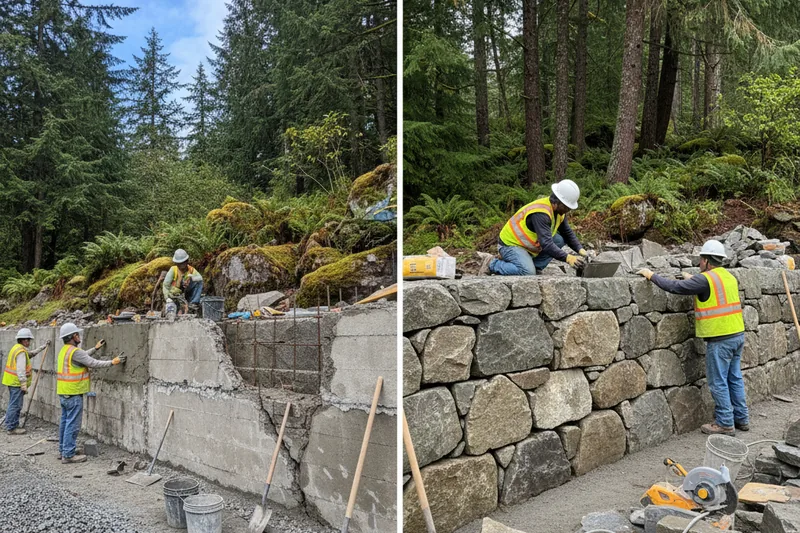
Retaining Wall Repair vs. Replacement: When is it Time to Rebuild?

Retaining Wall Repair vs. Replacement: When is it Time to Rebuild?

Request a Quote

Retaining Wall Repair vs. Replacement: When is it Time to Rebuild?

For many homeowners, a retaining wall is invisible—until it starts to fail.

One day, you notice a slight lean. Then, a few retaining wall cracks appear in the mortar. Suddenly, after a heavy week of rain, you realize the wall has shifted significantly, and the soil behind it is sinking.

The immediate question is almost always financial: Can I patch this up for a few hundred dollars, or am I looking at a massive construction project?

Making the wrong choice here has consequences. Patching a wall that has structural foundation issues is like putting a band-aid on a broken leg; it wastes money and delays the inevitable collapse. Conversely, tearing down a wall that only needed minor drainage improvements is an unnecessary expense.

This guide provides a clear decision framework to help you determine whether your retaining wall can be saved or if it is time to start fresh.

The “50% Rule”: A Quick Decision Framework

Before diving into the engineering details, professional retaining wall contractors often use a simple “rule of thumb” to give homeowners a reality check.

The Rule: If the cost of repairs equals or exceeds 50% of the cost of a new wall, you should replace it.

Why? Because a repaired wall is rarely as strong as a new one. “Frankenstein” repairs—where new materials are grafted onto old, failing structures—often fail again within 2 to 5 years. A new wall, built with modern drainage standards, should last 50+ years.

However, cost isn’t the only factor. You must also look at the extent of the damage.

Repairable: Damage is cosmetic or affects less than 25% of the wall’s surface.

Replace: Damage is structural (leaning/bulging) or affects more than 30–40% of the wall.

Warning Signs: Is Your Wall Just Ugly or Dangerous?

Not all cracks are created equal. To know if you need a total rebuild, you need to identify the type of failure occurring.

1. Leaning or “Bowing” (The Silent Killer)

If your wall looks like it is tipping forward at the top or bulging out in the middle, this is a structural failure. It usually means the foundation of the wall was not deep enough or the soil pressure behind the wall has exceeded what the material can handle.

  • Verdict: Almost always REPLACE. You cannot push a heavy retaining wall back into place. It must be dismantled to fix the foundation.

2. Separation from Adjacent Structures

Look at where the wall meets your driveway, patio, or garage. Is the wall pulling away? This indicates that the soil behind the wall is moving or settling.

  • Verdict: REPLACE. This is a sign of global instability in the slope.

3. Clogged Weep Holes and Puddling

Retaining walls are designed to let water pass through them (via weep holes or gravel backfill). If you see water pouring over the top of the wall during a storm, or if the wall stays wet for days after rain stops, the drainage system has failed.

  • Verdict: Potentially REPAIRABLE, but often requires excavating behind the wall to install new drainage, which is a major project.

Analyzing by Material: Repair vs. Replace Guidelines

The material your wall is built from changes the calculus significantly.

Timber and Railroad Ties

Wood has a finite lifespan. In damp climates, railroad tie retaining walls rot from the inside out.

  • Repair: If only the top cap is rotting but the rest of the timbers are solid, you can replace the top layer.
  • Replace: If you poke the lower timbers with a screwdriver and it sinks in, or if the wall is leaning, the wood has lost its structural integrity. Rot cannot be fixed. The entire wall must be removed.

Concrete Blocks (Segmental Walls)

These walls are durable, but they rely on interlocking friction.

  • Repair: If a few capstones have popped off or a tree root has pushed one section up, these specific blocks can often be reset.
  • Replace: If the wall is “bellying” (bulging in the center), it means the geogrid reinforcement inside the soil has snapped or pulled loose. The wall must be taken down to the failure point and rebuilt. (See how block walls are built to understand why internal grid failure is critical).

Natural Stone (Rockeries)

Rock walls rarely “break,” but they do shift.

  • Repair: If a single boulder has tumbled out, a machine can often place it back.
  • Replace: If the entire face of the rockery is sliding forward, the soil behind it has likely liquefied. The rocks must be removed, the slope regraded, and the wall restacked.

The Root Cause: Why Did It Fail?

If you choose to replace your wall, you must ensure the new one doesn’t suffer the same fate. Most retaining walls fail for one of two reasons:

1. The Enemy is Water (Hydrostatic Pressure)

Water is heavy. When soil gets saturated, its weight can double. If that water has nowhere to go, it pushes against the back of your wall with immense force (hydrostatic pressure).

  • The Fix: A professional replacement will always include a “burrito wrap” drainage system: perforated pipe wrapped in filter fabric, covered by at least 12 inches of clear gravel backfill.

2. Poor Foundation (Settling)

A wall is only as stable as the ground it sits on. If the original builder didn’t dig a deep enough trench or failed to compact the base gravel, the wall will sink.

  • The Fix: The new wall must be built on a compacted aggregate base that is buried below the frost line to prevent heaving.

Cost Analysis: Repair vs. Rebuild

Homeowners are often shocked by the cost of repairs. Why is it so expensive just to fix a small section?

The “Mobilization” Factor Contractors have fixed costs—getting the excavator to your house, hauling away debris, and buying materials. Whether they are fixing 10 feet or building 50 feet, these startup costs remain similar.

  • Repair Costs: Labor-intensive. It often involves careful demolition to save existing materials, which takes longer than simply demolishing the whole thing.
  • Replacement Costs: While higher in total, the “price per square foot” is often better because the crew can work efficiently without trying to salvage old, failing structures.

For a detailed look at current pricing for new builds, see our guide on Retaining Wall Costs in Seattle.

The Replacement Timeline: What to Expect

If you decide that replacement is the only safe option, here is what the process looks like:

  1. Demolition (1–2 Days): The old wall is removed. If it’s treated timber, it must be disposed of at a specialized facility. Concrete can often be recycled.
  2. Excavation & Grading (1–2 Days): The slope is cut back to allow room for drainage.
  3. Base Prep (1 Day): A new, level sub-base is compacted.
  4. Reconstruction (3–5 Days): The new wall is built, with drainage pipe installed behind the first course of block or stone.
  5. Backfill & Cleanup (1 Day): The area behind the wall is filled with gravel and soil, then graded for landscaping.

Frequently Asked Questions

Can I just add a new wall in front of the old one? This is a common question, but rarely a good idea. The old wall will continue to push against the new one, adding “surcharge” weight that the new wall wasn’t designed to hold. It usually leads to a double failure.

Does homeowners insurance cover retaining wall failure? Typically, no. Most policies classify retaining walls as “detached structures” and exclude damage caused by “earth movement” or “wear and tear.” However, if a wall collapses and damages your house or a car, that secondary damage might be covered. Check your specific policy.

Can I repair a leaning wall by adding buttresses? In some commercial cases, yes. But for residential walls, building buttresses (supports in front of the wall) usually costs as much as rebuilding, looks unattractive, and eats up valuable yard space.

Conclusion: Don’t Wait Until It Collapses

A failing retaining wall is a hazard. It threatens your landscape, your safety, and potentially your home’s foundation.

If your wall is just showing minor surface wear, a repair might be feasible. But if you see leaning, bulging, or significant rot, replacement is the only way to protect your property value.

The peace of mind that comes from a properly engineered wall—one that handles drainage correctly and will last for decades—is worth the investment.

For many homeowners, a retaining wall is invisible—until it starts to fail.

One day, you notice a slight lean. Then, a few retaining wall cracks appear in the mortar. Suddenly, after a heavy week of rain, you realize the wall has shifted significantly, and the soil behind it is sinking.

The immediate question is almost always financial: Can I patch this up for a few hundred dollars, or am I looking at a massive construction project?

Making the wrong choice here has consequences. Patching a wall that has structural foundation issues is like putting a band-aid on a broken leg; it wastes money and delays the inevitable collapse. Conversely, tearing down a wall that only needed minor drainage improvements is an unnecessary expense.

This guide provides a clear decision framework to help you determine whether your retaining wall can be saved or if it is time to start fresh.

The “50% Rule”: A Quick Decision Framework

Before diving into the engineering details, professional retaining wall contractors often use a simple “rule of thumb” to give homeowners a reality check.

The Rule: If the cost of repairs equals or exceeds 50% of the cost of a new wall, you should replace it.

Why? Because a repaired wall is rarely as strong as a new one. “Frankenstein” repairs—where new materials are grafted onto old, failing structures—often fail again within 2 to 5 years. A new wall, built with modern drainage standards, should last 50+ years.

However, cost isn’t the only factor. You must also look at the extent of the damage.

  • Repairable: Damage is cosmetic or affects less than 25% of the wall’s surface.

  • Replace: Damage is structural (leaning/bulging) or affects more than 30–40% of the wall.

Warning Signs: Is Your Wall Just Ugly or Dangerous?

Not all cracks are created equal. To know if you need a total rebuild, you need to identify the type of failure occurring.

1. Leaning or “Bowing” (The Silent Killer)

If your wall looks like it is tipping forward at the top or bulging out in the middle, this is a structural failure. It usually means the foundation of the wall was not deep enough or the soil pressure behind the wall has exceeded what the material can handle.

  • Verdict: Almost always REPLACE. You cannot push a heavy retaining wall back into place. It must be dismantled to fix the foundation.

2. Separation from Adjacent Structures

Look at where the wall meets your driveway, patio, or garage. Is the wall pulling away? This indicates that the soil behind the wall is moving or settling.

  • Verdict: REPLACE. This is a sign of global instability in the slope.

3. Clogged Weep Holes and Puddling

Retaining walls are designed to let water pass through them (via weep holes or gravel backfill). If you see water pouring over the top of the wall during a storm, or if the wall stays wet for days after rain stops, the drainage system has failed.

  • Verdict: Potentially REPAIRABLE, but often requires excavating behind the wall to install new drainage, which is a major project.


Analyzing by Material: Repair vs. Replace Guidelines

The material your wall is built from changes the calculus significantly.

Timber and Railroad Ties

Wood has a finite lifespan. In damp climates, railroad tie retaining walls rot from the inside out.

  • Repair: If only the top cap is rotting but the rest of the timbers are solid, you can replace the top layer.

  • Replace: If you poke the lower timbers with a screwdriver and it sinks in, or if the wall is leaning, the wood has lost its structural integrity. Rot cannot be fixed. The entire wall must be removed.

Concrete Blocks (Segmental Walls)

These walls are durable, but they rely on interlocking friction.

  • Repair: If a few capstones have popped off or a tree root has pushed one section up, these specific blocks can often be reset.

  • Replace: If the wall is “bellying” (bulging in the center), it means the geogrid reinforcement inside the soil has snapped or pulled loose. The wall must be taken down to the failure point and rebuilt. (See how block walls are built to understand why internal grid failure is critical).

Natural Stone (Rockeries)

Rock walls rarely “break,” but they do shift.

  • Repair: If a single boulder has tumbled out, a machine can often place it back.

  • Replace: If the entire face of the rockery is sliding forward, the soil behind it has likely liquefied. The rocks must be removed, the slope regraded, and the wall restacked.

The Root Cause: Why Did It Fail?

If you choose to replace your wall, you must ensure the new one doesn’t suffer the same fate. Most retaining walls fail for one of two reasons:

1. The Enemy is Water (Hydrostatic Pressure)

Water is heavy. When soil gets saturated, its weight can double. If that water has nowhere to go, it pushes against the back of your wall with immense force (hydrostatic pressure).

  • The Fix: A professional replacement will always include a “burrito wrap” drainage system: perforated pipe wrapped in filter fabric, covered by at least 12 inches of clear gravel backfill.

2. Poor Foundation (Settling)

A wall is only as stable as the ground it sits on. If the original builder didn’t dig a deep enough trench or failed to compact the base gravel, the wall will sink.

  • The Fix: The new wall must be built on a compacted aggregate base that is buried below the frost line to prevent heaving.


Cost Analysis: Repair vs. Rebuild

Homeowners are often shocked by the cost of repairs. Why is it so expensive just to fix a small section?

The “Mobilization” Factor Contractors have fixed costs—getting the excavator to your house, hauling away debris, and buying materials. Whether they are fixing 10 feet or building 50 feet, these startup costs remain similar.

  • Repair Costs: Labor-intensive. It often involves careful demolition to save existing materials, which takes longer than simply demolishing the whole thing.

  • Replacement Costs: While higher in total, the “price per square foot” is often better because the crew can work efficiently without trying to salvage old, failing structures.

For a detailed look at current pricing for new builds, see our guide on Retaining Wall Costs in Seattle.

The Replacement Timeline: What to Expect

If you decide that replacement is the only safe option, here is what the process looks like:

  1. Demolition (1–2 Days): The old wall is removed. If it’s treated timber, it must be disposed of at a specialized facility. Concrete can often be recycled.

  2. Excavation & Grading (1–2 Days): The slope is cut back to allow room for drainage.

  3. Base Prep (1 Day): A new, level sub-base is compacted.

  4. Reconstruction (3–5 Days): The new wall is built, with drainage pipe installed behind the first course of block or stone.

  5. Backfill & Cleanup (1 Day): The area behind the wall is filled with gravel and soil, then graded for landscaping.

Frequently Asked Questions

Can I just add a new wall in front of the old one? This is a common question, but rarely a good idea. The old wall will continue to push against the new one, adding “surcharge” weight that the new wall wasn’t designed to hold. It usually leads to a double failure.

Does homeowners insurance cover retaining wall failure? Typically, no. Most policies classify retaining walls as “detached structures” and exclude damage caused by “earth movement” or “wear and tear.” However, if a wall collapses and damages your house or a car, that secondary damage might be covered. Check your specific policy.

Can I repair a leaning wall by adding buttresses? In some commercial cases, yes. But for residential walls, building buttresses (supports in front of the wall) usually costs as much as rebuilding, looks unattractive, and eats up valuable yard space.

Conclusion: Don’t Wait Until It Collapses

A failing retaining wall is a hazard. It threatens your landscape, your safety, and potentially your home’s foundation.

If your wall is just showing minor surface wear, a repair might be feasible. But if you see leaning, bulging, or significant rot, replacement is the only way to protect your property value.

The peace of mind that comes from a properly engineered wall—one that handles drainage correctly and will last for decades—is worth the investment.

Request a Quote

For many homeowners, a retaining wall is invisible—until it starts to fail.

One day, you notice a slight lean. Then, a few retaining wall cracks appear in the mortar. Suddenly, after a heavy week of rain, you realize the wall has shifted significantly, and the soil behind it is sinking.

The immediate question is almost always financial: Can I patch this up for a few hundred dollars, or am I looking at a massive construction project?

Making the wrong choice here has consequences. Patching a wall that has structural foundation issues is like putting a band-aid on a broken leg; it wastes money and delays the inevitable collapse. Conversely, tearing down a wall that only needed minor drainage improvements is an unnecessary expense.

This guide provides a clear decision framework to help you determine whether your retaining wall can be saved or if it is time to start fresh.

The “50% Rule”: A Quick Decision Framework

Before diving into the engineering details, professional retaining wall contractors often use a simple “rule of thumb” to give homeowners a reality check.

The Rule: If the cost of repairs equals or exceeds 50% of the cost of a new wall, you should replace it.

Why? Because a repaired wall is rarely as strong as a new one. “Frankenstein” repairs—where new materials are grafted onto old, failing structures—often fail again within 2 to 5 years. A new wall, built with modern drainage standards, should last 50+ years.

However, cost isn’t the only factor. You must also look at the extent of the damage.

Repairable: Damage is cosmetic or affects less than 25% of the wall’s surface.

Replace: Damage is structural (leaning/bulging) or affects more than 30–40% of the wall.

Warning Signs: Is Your Wall Just Ugly or Dangerous?

Not all cracks are created equal. To know if you need a total rebuild, you need to identify the type of failure occurring.

1. Leaning or “Bowing” (The Silent Killer)

If your wall looks like it is tipping forward at the top or bulging out in the middle, this is a structural failure. It usually means the foundation of the wall was not deep enough or the soil pressure behind the wall has exceeded what the material can handle.

  • Verdict: Almost always REPLACE. You cannot push a heavy retaining wall back into place. It must be dismantled to fix the foundation.

2. Separation from Adjacent Structures

Look at where the wall meets your driveway, patio, or garage. Is the wall pulling away? This indicates that the soil behind the wall is moving or settling.

  • Verdict: REPLACE. This is a sign of global instability in the slope.

3. Clogged Weep Holes and Puddling

Retaining walls are designed to let water pass through them (via weep holes or gravel backfill). If you see water pouring over the top of the wall during a storm, or if the wall stays wet for days after rain stops, the drainage system has failed.

  • Verdict: Potentially REPAIRABLE, but often requires excavating behind the wall to install new drainage, which is a major project.

Analyzing by Material: Repair vs. Replace Guidelines

The material your wall is built from changes the calculus significantly.

Timber and Railroad Ties

Wood has a finite lifespan. In damp climates, railroad tie retaining walls rot from the inside out.

  • Repair: If only the top cap is rotting but the rest of the timbers are solid, you can replace the top layer.
  • Replace: If you poke the lower timbers with a screwdriver and it sinks in, or if the wall is leaning, the wood has lost its structural integrity. Rot cannot be fixed. The entire wall must be removed.

Concrete Blocks (Segmental Walls)

These walls are durable, but they rely on interlocking friction.

  • Repair: If a few capstones have popped off or a tree root has pushed one section up, these specific blocks can often be reset.
  • Replace: If the wall is “bellying” (bulging in the center), it means the geogrid reinforcement inside the soil has snapped or pulled loose. The wall must be taken down to the failure point and rebuilt. (See how block walls are built to understand why internal grid failure is critical).

Natural Stone (Rockeries)

Rock walls rarely “break,” but they do shift.

  • Repair: If a single boulder has tumbled out, a machine can often place it back.
  • Replace: If the entire face of the rockery is sliding forward, the soil behind it has likely liquefied. The rocks must be removed, the slope regraded, and the wall restacked.

The Root Cause: Why Did It Fail?

If you choose to replace your wall, you must ensure the new one doesn’t suffer the same fate. Most retaining walls fail for one of two reasons:

1. The Enemy is Water (Hydrostatic Pressure)

Water is heavy. When soil gets saturated, its weight can double. If that water has nowhere to go, it pushes against the back of your wall with immense force (hydrostatic pressure).

  • The Fix: A professional replacement will always include a “burrito wrap” drainage system: perforated pipe wrapped in filter fabric, covered by at least 12 inches of clear gravel backfill.

2. Poor Foundation (Settling)

A wall is only as stable as the ground it sits on. If the original builder didn’t dig a deep enough trench or failed to compact the base gravel, the wall will sink.

  • The Fix: The new wall must be built on a compacted aggregate base that is buried below the frost line to prevent heaving.

Cost Analysis: Repair vs. Rebuild

Homeowners are often shocked by the cost of repairs. Why is it so expensive just to fix a small section?

The “Mobilization” Factor Contractors have fixed costs—getting the excavator to your house, hauling away debris, and buying materials. Whether they are fixing 10 feet or building 50 feet, these startup costs remain similar.

  • Repair Costs: Labor-intensive. It often involves careful demolition to save existing materials, which takes longer than simply demolishing the whole thing.
  • Replacement Costs: While higher in total, the “price per square foot” is often better because the crew can work efficiently without trying to salvage old, failing structures.

For a detailed look at current pricing for new builds, see our guide on Retaining Wall Costs in Seattle.

The Replacement Timeline: What to Expect

If you decide that replacement is the only safe option, here is what the process looks like:

  1. Demolition (1–2 Days): The old wall is removed. If it’s treated timber, it must be disposed of at a specialized facility. Concrete can often be recycled.
  2. Excavation & Grading (1–2 Days): The slope is cut back to allow room for drainage.
  3. Base Prep (1 Day): A new, level sub-base is compacted.
  4. Reconstruction (3–5 Days): The new wall is built, with drainage pipe installed behind the first course of block or stone.
  5. Backfill & Cleanup (1 Day): The area behind the wall is filled with gravel and soil, then graded for landscaping.

Frequently Asked Questions

Can I just add a new wall in front of the old one? This is a common question, but rarely a good idea. The old wall will continue to push against the new one, adding “surcharge” weight that the new wall wasn’t designed to hold. It usually leads to a double failure.

Does homeowners insurance cover retaining wall failure? Typically, no. Most policies classify retaining walls as “detached structures” and exclude damage caused by “earth movement” or “wear and tear.” However, if a wall collapses and damages your house or a car, that secondary damage might be covered. Check your specific policy.

Can I repair a leaning wall by adding buttresses? In some commercial cases, yes. But for residential walls, building buttresses (supports in front of the wall) usually costs as much as rebuilding, looks unattractive, and eats up valuable yard space.

Conclusion: Don’t Wait Until It Collapses

A failing retaining wall is a hazard. It threatens your landscape, your safety, and potentially your home’s foundation.

If your wall is just showing minor surface wear, a repair might be feasible. But if you see leaning, bulging, or significant rot, replacement is the only way to protect your property value.

The peace of mind that comes from a properly engineered wall—one that handles drainage correctly and will last for decades—is worth the investment.

For many homeowners, a retaining wall is invisible—until it starts to fail.

One day, you notice a slight lean. Then, a few retaining wall cracks appear in the mortar. Suddenly, after a heavy week of rain, you realize the wall has shifted significantly, and the soil behind it is sinking.

The immediate question is almost always financial: Can I patch this up for a few hundred dollars, or am I looking at a massive construction project?

Making the wrong choice here has consequences. Patching a wall that has structural foundation issues is like putting a band-aid on a broken leg; it wastes money and delays the inevitable collapse. Conversely, tearing down a wall that only needed minor drainage improvements is an unnecessary expense.

This guide provides a clear decision framework to help you determine whether your retaining wall can be saved or if it is time to start fresh.

The “50% Rule”: A Quick Decision Framework

Before diving into the engineering details, professional retaining wall contractors often use a simple “rule of thumb” to give homeowners a reality check.

The Rule: If the cost of repairs equals or exceeds 50% of the cost of a new wall, you should replace it.

Why? Because a repaired wall is rarely as strong as a new one. “Frankenstein” repairs—where new materials are grafted onto old, failing structures—often fail again within 2 to 5 years. A new wall, built with modern drainage standards, should last 50+ years.

However, cost isn’t the only factor. You must also look at the extent of the damage.

  • Repairable: Damage is cosmetic or affects less than 25% of the wall’s surface.

  • Replace: Damage is structural (leaning/bulging) or affects more than 30–40% of the wall.

Warning Signs: Is Your Wall Just Ugly or Dangerous?

Not all cracks are created equal. To know if you need a total rebuild, you need to identify the type of failure occurring.

1. Leaning or “Bowing” (The Silent Killer)

If your wall looks like it is tipping forward at the top or bulging out in the middle, this is a structural failure. It usually means the foundation of the wall was not deep enough or the soil pressure behind the wall has exceeded what the material can handle.

  • Verdict: Almost always REPLACE. You cannot push a heavy retaining wall back into place. It must be dismantled to fix the foundation.

2. Separation from Adjacent Structures

Look at where the wall meets your driveway, patio, or garage. Is the wall pulling away? This indicates that the soil behind the wall is moving or settling.

  • Verdict: REPLACE. This is a sign of global instability in the slope.

3. Clogged Weep Holes and Puddling

Retaining walls are designed to let water pass through them (via weep holes or gravel backfill). If you see water pouring over the top of the wall during a storm, or if the wall stays wet for days after rain stops, the drainage system has failed.

  • Verdict: Potentially REPAIRABLE, but often requires excavating behind the wall to install new drainage, which is a major project.


Analyzing by Material: Repair vs. Replace Guidelines

The material your wall is built from changes the calculus significantly.

Timber and Railroad Ties

Wood has a finite lifespan. In damp climates, railroad tie retaining walls rot from the inside out.

  • Repair: If only the top cap is rotting but the rest of the timbers are solid, you can replace the top layer.

  • Replace: If you poke the lower timbers with a screwdriver and it sinks in, or if the wall is leaning, the wood has lost its structural integrity. Rot cannot be fixed. The entire wall must be removed.

Concrete Blocks (Segmental Walls)

These walls are durable, but they rely on interlocking friction.

  • Repair: If a few capstones have popped off or a tree root has pushed one section up, these specific blocks can often be reset.

  • Replace: If the wall is “bellying” (bulging in the center), it means the geogrid reinforcement inside the soil has snapped or pulled loose. The wall must be taken down to the failure point and rebuilt. (See how block walls are built to understand why internal grid failure is critical).

Natural Stone (Rockeries)

Rock walls rarely “break,” but they do shift.

  • Repair: If a single boulder has tumbled out, a machine can often place it back.

  • Replace: If the entire face of the rockery is sliding forward, the soil behind it has likely liquefied. The rocks must be removed, the slope regraded, and the wall restacked.

The Root Cause: Why Did It Fail?

If you choose to replace your wall, you must ensure the new one doesn’t suffer the same fate. Most retaining walls fail for one of two reasons:

1. The Enemy is Water (Hydrostatic Pressure)

Water is heavy. When soil gets saturated, its weight can double. If that water has nowhere to go, it pushes against the back of your wall with immense force (hydrostatic pressure).

  • The Fix: A professional replacement will always include a “burrito wrap” drainage system: perforated pipe wrapped in filter fabric, covered by at least 12 inches of clear gravel backfill.

2. Poor Foundation (Settling)

A wall is only as stable as the ground it sits on. If the original builder didn’t dig a deep enough trench or failed to compact the base gravel, the wall will sink.

  • The Fix: The new wall must be built on a compacted aggregate base that is buried below the frost line to prevent heaving.


Cost Analysis: Repair vs. Rebuild

Homeowners are often shocked by the cost of repairs. Why is it so expensive just to fix a small section?

The “Mobilization” Factor Contractors have fixed costs—getting the excavator to your house, hauling away debris, and buying materials. Whether they are fixing 10 feet or building 50 feet, these startup costs remain similar.

  • Repair Costs: Labor-intensive. It often involves careful demolition to save existing materials, which takes longer than simply demolishing the whole thing.

  • Replacement Costs: While higher in total, the “price per square foot” is often better because the crew can work efficiently without trying to salvage old, failing structures.

For a detailed look at current pricing for new builds, see our guide on Retaining Wall Costs in Seattle.

The Replacement Timeline: What to Expect

If you decide that replacement is the only safe option, here is what the process looks like:

  1. Demolition (1–2 Days): The old wall is removed. If it’s treated timber, it must be disposed of at a specialized facility. Concrete can often be recycled.

  2. Excavation & Grading (1–2 Days): The slope is cut back to allow room for drainage.

  3. Base Prep (1 Day): A new, level sub-base is compacted.

  4. Reconstruction (3–5 Days): The new wall is built, with drainage pipe installed behind the first course of block or stone.

  5. Backfill & Cleanup (1 Day): The area behind the wall is filled with gravel and soil, then graded for landscaping.

Frequently Asked Questions

Can I just add a new wall in front of the old one? This is a common question, but rarely a good idea. The old wall will continue to push against the new one, adding “surcharge” weight that the new wall wasn’t designed to hold. It usually leads to a double failure.

Does homeowners insurance cover retaining wall failure? Typically, no. Most policies classify retaining walls as “detached structures” and exclude damage caused by “earth movement” or “wear and tear.” However, if a wall collapses and damages your house or a car, that secondary damage might be covered. Check your specific policy.

Can I repair a leaning wall by adding buttresses? In some commercial cases, yes. But for residential walls, building buttresses (supports in front of the wall) usually costs as much as rebuilding, looks unattractive, and eats up valuable yard space.

Conclusion: Don’t Wait Until It Collapses

A failing retaining wall is a hazard. It threatens your landscape, your safety, and potentially your home’s foundation.

If your wall is just showing minor surface wear, a repair might be feasible. But if you see leaning, bulging, or significant rot, replacement is the only way to protect your property value.

The peace of mind that comes from a properly engineered wall—one that handles drainage correctly and will last for decades—is worth the investment.