
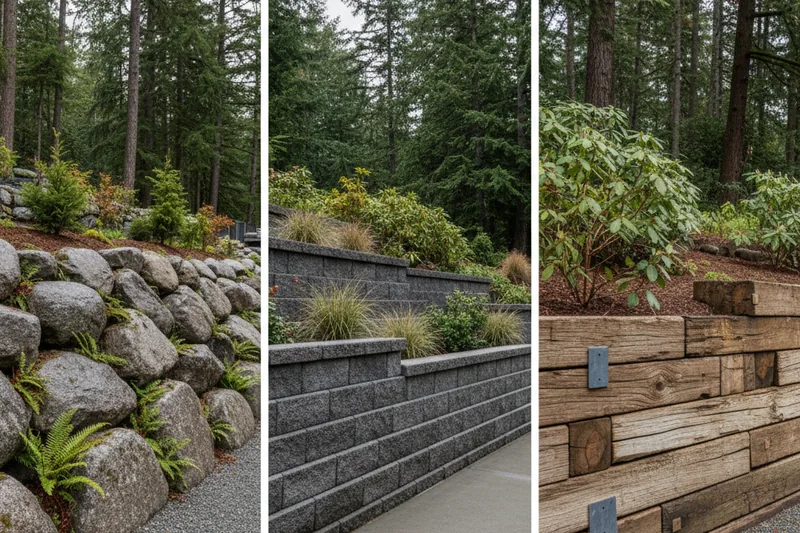
Rockery vs. Concrete Block vs. Timber Which Retaining Wall Material is Right for You?

Rockery vs. Concrete Block vs. Timber Which Retaining Wall Material is Right for You?

Request a Quote

Rockery vs. Concrete Block vs. Timber Which Retaining Wall Material is Right for You?

When you realize you need a retaining wall, the first question is usually about cost. But the second question—and arguably the more important one—is about materials.

Should you go with the natural look of a rockery? The structural precision of concrete blocks? Or the budget-friendly appeal of timber?

This isn’t just an aesthetic choice. The material you select dictates the lifespan of the wall, how much maintenance it will require, and whether it can actually hold back the specific soil load of your property.

If you choose the wrong material for your specific terrain, you might find yourself rebuilding it in five years.

This guide provides an honest, side-by-side comparison of the three most popular retaining wall materials in the Pacific Northwest: Timber, Interlocking Concrete Blocks, and Natural Rockeries.

The “Big Three” at a Glance

Before diving into the details, here is a quick decision matrix to help you orient yourself.

Feature

Timber / Railroad Ties

Concrete Block (Segmental)

Rockery / Natural Stone

Primary Benefit

Low initial cost

Structural strength

Aesthetic & Drainage

Typical Lifespan

10–15 Years

50–100 Years

50+ Years (Lifetime)

Maintenance

High (Rot checks)

Low

Low (Occasional weeding)

Best For

Short walls, tight budgets

Tall walls, tight spaces

Slopes, natural gardens

Option 1: Timber and Railroad Ties

The Budget-Friendly, Rustic Choice

Timber walls remain a staple in residential landscaping because they are affordable and relatively easy to install. They offer a warm, rustic aesthetic that blends seamlessly with garden beds and natural wood fences.

How It Works

Railroad tie retaining walls and timber walls are built using pressure-treated lumber (often 6x6s). The timbers are stacked and secured together using long landscaping spikes (rebar). To anchor the wall into the hill, “deadmen” (perpendicular timbers) are buried into the slope behind the wall to use the soil’s own weight to hold the face in place.

The Pros

  • Cost: This is almost always the least expensive professional option. Materials are readily available and lightweight compared to stone.

  • Speed: A professional crew can install a timber wall faster than stone or block walls, reducing labor hours.

  • Aesthetic: Many homeowners prefer the softer, organic look of wood over the industrial look of concrete.

The Cons

  • Rot and Decay: This is the unavoidable reality of wood. Even chemically treated “ground contact” lumber will eventually rot, especially in damp climates like Seattle or Lynnwood.

  • Short Lifespan: You can expect 10 to 15 years out of a well-built timber wall. If drainage is poor, it could fail in less than a decade.

  • Pests: Damp wood can attract carpenter ants and other pests.

Verdict

Timber is an excellent choice if you are on a strict budget or if you are building a low garden wall (under 3 feet) that doesn’t protect a home foundation. However, view it as a semi-permanent solution. You will have to replace it.

Option 2: Interlocking Concrete Blocks (Segmental Walls)

The Engineer’s Choice for Durability

If you drive past a new commercial development or a highway overpass, you will likely see segmental retaining walls (SRWs). These are manufactured concrete blocks designed specifically to hold back massive amounts of earth.

How It Works

These walls do not use mortar. Instead, the blocks are designed with a lip or a pin system that locks each row to the one below it. (See our guide on the 5 steps for block retaining walls to understand the construction.) As the wall gets taller, it leans slightly back into the hill (batter), using gravity and friction to stay upright. For walls over 4 feet, a “geogrid” (a strong synthetic mesh) is often buried between the block layers and extended back into the soil to anchor the system.

The Pros

  • Extreme Durability: Concrete does not rot, warp, or rust. These walls can easily last 50 to 100 years.

  • Design Flexibility: Blocks come in dozens of colors, textures, and sizes. You can create curves, corners, and stairs easily.

  • Structural Integrity: This is the safest option for tall walls or walls that support a driveway (surcharge).

The Cons

  • Commercial Look: Some homeowners feel that concrete blocks look too “industrial” or manicured for a natural-style garden.

  • Cost: Blocks are more expensive to manufacture and ship than wood, raising the material cost.

  • Drainage Sensitivity: Because the face is solid, internal drainage (gravel and pipes) is critical. If water gets trapped behind the blocks, the hydrostatic pressure can push the wall over.

Verdict

Choose concrete blocks if you need a “buy it for life” solution. They are the best option for critical structural walls, steep vertical grades, or tight spaces where you don’t have room for the slope of a rockery.

Option 3: Rockeries (Natural Stone)

The Pacific Northwest Classic

A “rockery” is distinct from a mortared stone wall. In a rockery, large boulders (often basalt or granite) are stacked in a way that uses gravity to hold the slope. It is less of a “wall” and more of a stabilized slope armor.

How It Works

Large “2-man” or “3-man” rocks are stacked against a cut slope. Unlike block walls which can be near-vertical, rockeries require a significant backward lean. The gaps between the rocks are filled with smaller rocks or plants.

The Pros

  • Superior Drainage: Because the wall is not solid, water flows freely through the gaps between rocks. This naturally relieves hydrostatic pressure, which is the #1 cause of wall failure.

  • Aesthetics: Nothing looks more natural in a PNW landscape than local basalt and moss. It ages beautifully.

  • Durability: Rocks don’t rot. A well-built rockery can last a lifetime, though it may need minor re-stacking after several decades.

The Cons

  • Space Requirements: Because rockeries lean back significantly, they eat up more yard space than a vertical block wall.

  • Access Issues: How to move large rocks is a logistical challenge. It requires heavy machinery. If a machine cannot fit into your backyard, a rockery is likely impossible or cost-prohibitive.

  • Skill Dependent: Stacking random rocks so they lock together securely is an art form. It requires a highly skilled operator.

Verdict

Rockeries are the ideal choice for stabilization and erosion control on properties that have easy machine access. They offer the best balance of drainage, longevity, and natural beauty.

Pricing Comparison: Seattle Market Averages (2026)

Most homeowners want a rough idea of what other people in the Seattle area are paying before they call for a quote.

While every site is different (access, soil type, and engineering can all change the price), these are the typical price ranges per square foot you will see from licensed, bonded, and insured contractors in King County.

Material

Average Cost (Installed)*

What Drives the Cost?

Timber / Wood

$40 – $60 / sq. ft.

Lowest material cost; easier labor.

Concrete Block

$55 – $85 / sq. ft.

Higher material cost; precise labor needed.

Rockery / Stone

$50 – $90 / sq. ft.

Heavy machinery fuel; highly skilled operator.

Poured Concrete

$90 – $140+ / sq. ft.

Expensive forms, rebar, and concrete pumps.

*Note: “Square foot” refers to the face of the wall (Height x Length). These averages typically cover standard installation, materials, and gravel backfill. Complex engineering, permits, or difficult site access will push these numbers toward the higher end.

For a detailed breakdown of these costs, read our Ultimate Guide to Retaining Wall Costs in Seattle.

Critical Factor: Access and Terrain

Sometimes, the decision is made for you by your property itself.

When to Rule Out Rockeries:

If your retaining wall needs to be located in a side yard with only a 3-foot wide gate, you cannot build a rockery. The heavy excavators required to lift the boulders simply won’t fit. In this case, Timber or small Modular Blocks (which can be carried by hand or wheelbarrow) are your only options.

When to Rule Out Timber:

If you are cutting into a slope to create a driveway or a foundation for a garage, do not use timber. You need a material with a lifespan that matches the driveway (50+ years). You do not want to tear up your driveway in 15 years to replace a rotting wood wall.

Common Mistakes to Avoid

Regardless of which material you choose, the same physics apply. Here are the most common reasons we are called to repair or replace existing walls.

  1. Ignoring Drainage: We cannot stress this enough. If you build a concrete block wall and backfill it with dirt instead of gravel, it will fail. You must provide a path for water to escape.

  2. Bad Base Prep: A wall is only as good as its footer. If the contractor doesn’t compact the base gravel correctly, the wall will settle, leading to retaining wall cracks or uneven lines.

  3. Over-planting: Planting large trees right on top of a retaining wall is a recipe for disaster. Tree roots are powerful enough to push massive boulders and concrete blocks out of alignment over time.

Final Decision Guide

Choose Timber If:

  • You have a limited budget.

  • The wall is decorative or low-height (under 3 feet).

  • You plan to move in the next 5–10 years.

  • You love the rustic, garden aesthetic.

Choose Concrete Block If:

  • You need to maximize usable flat space (vertical build).

  • The wall is supporting a driveway or structure.

  • You want a “one and done” solution that never needs replacement.

  • You prefer a clean, modern, or manicured look.

Choose Rockery If:

  • You have good machine access to the site.

  • You want excellent natural drainage.

  • You want the wall to blend into the natural landscape.

  • You have enough room for the wall to lean back slightly.

Conclusion

There is no single “best” material—only the best material for your specific project.

A timber wall might be the perfect solution for a raised vegetable garden, while a concrete block wall is the only responsible choice for holding up a parking pad. The key is to balance your budget with your long-term goals for the property.

If you are still unsure which material fits your terrain, the best step is to have a retaining wall contractor assess the grade and soil stability.

When you realize you need a retaining wall, the first question is usually about cost. But the second question—and arguably the more important one—is about materials.

Should you go with the natural look of a rockery? The structural precision of concrete blocks? Or the budget-friendly appeal of timber?

This isn’t just an aesthetic choice. The material you select dictates the lifespan of the wall, how much maintenance it will require, and whether it can actually hold back the specific soil load of your property.

If you choose the wrong material for your specific terrain, you might find yourself rebuilding it in five years.

This guide provides an honest, side-by-side comparison of the three most popular retaining wall materials in the Pacific Northwest: Timber, Interlocking Concrete Blocks, and Natural Rockeries.


The “Big Three” at a Glance

Before diving into the details, here is a quick decision matrix to help you orient yourself.

FeatureTimber / Railroad TiesConcrete Block (Segmental)Rockery / Natural Stone
Primary BenefitLow initial costStructural strengthAesthetic & Drainage
Typical Lifespan10–15 Years50–100 Years50+ Years (Lifetime)
MaintenanceHigh (Rot checks)LowLow (Occasional weeding)
Best ForShort walls, tight budgetsTall walls, tight spacesSlopes, natural gardens


Option 1: Timber and Railroad Ties

The Budget-Friendly, Rustic Choice

Timber walls remain a staple in residential landscaping because they are affordable and relatively easy to install. They offer a warm, rustic aesthetic that blends seamlessly with garden beds and natural wood fences.


How It Works

Railroad tie retaining walls and timber walls are built using pressure-treated lumber (often 6x6s). The timbers are stacked and secured together using long landscaping spikes (rebar). To anchor the wall into the hill, “deadmen” (perpendicular timbers) are buried into the slope behind the wall to use the soil’s own weight to hold the face in place.


The Pros

  • Cost: This is almost always the least expensive professional option. Materials are readily available and lightweight compared to stone.

  • Speed: A professional crew can install a timber wall faster than stone or block walls, reducing labor hours.

  • Aesthetic: Many homeowners prefer the softer, organic look of wood over the industrial look of concrete.


The Cons

  • Rot and Decay: This is the unavoidable reality of wood. Even chemically treated “ground contact” lumber will eventually rot, especially in damp climates like Seattle or Lynnwood.

  • Short Lifespan: You can expect 10 to 15 years out of a well-built timber wall. If drainage is poor, it could fail in less than a decade.

  • Pests: Damp wood can attract carpenter ants and other pests.


Verdict

Timber is an excellent choice if you are on a strict budget or if you are building a low garden wall (under 3 feet) that doesn’t protect a home foundation. However, view it as a semi-permanent solution. You will have to replace it.


Option 2: Interlocking Concrete Blocks (Segmental Walls)

The Engineer’s Choice for Durability

If you drive past a new commercial development or a highway overpass, you will likely see segmental retaining walls (SRWs). These are manufactured concrete blocks designed specifically to hold back massive amounts of earth.


How It Works

These walls do not use mortar. Instead, the blocks are designed with a lip or a pin system that locks each row to the one below it. (See our guide on the 5 steps for block retaining walls to understand the construction.) As the wall gets taller, it leans slightly back into the hill (batter), using gravity and friction to stay upright. For walls over 4 feet, a “geogrid” (a strong synthetic mesh) is often buried between the block layers and extended back into the soil to anchor the system.


The Pros

  • Extreme Durability: Concrete does not rot, warp, or rust. These walls can easily last 50 to 100 years.

  • Design Flexibility: Blocks come in dozens of colors, textures, and sizes. You can create curves, corners, and stairs easily.

  • Structural Integrity: This is the safest option for tall walls or walls that support a driveway (surcharge).


The Cons

  • Commercial Look: Some homeowners feel that concrete blocks look too “industrial” or manicured for a natural-style garden.

  • Cost: Blocks are more expensive to manufacture and ship than wood, raising the material cost.

  • Drainage Sensitivity: Because the face is solid, internal drainage (gravel and pipes) is critical. If water gets trapped behind the blocks, the hydrostatic pressure can push the wall over.


Verdict

Choose concrete blocks if you need a “buy it for life” solution. They are the best option for critical structural walls, steep vertical grades, or tight spaces where you don’t have room for the slope of a rockery.


Option 3: Rockeries (Natural Stone)

The Pacific Northwest Classic

A “rockery” is distinct from a mortared stone wall. In a rockery, large boulders (often basalt or granite) are stacked in a way that uses gravity to hold the slope. It is less of a “wall” and more of a stabilized slope armor.


How It Works

Large “2-man” or “3-man” rocks are stacked against a cut slope. Unlike block walls which can be near-vertical, rockeries require a significant backward lean. The gaps between the rocks are filled with smaller rocks or plants.


The Pros

  • Superior Drainage: Because the wall is not solid, water flows freely through the gaps between rocks. This naturally relieves hydrostatic pressure, which is the #1 cause of wall failure.

  • Aesthetics: Nothing looks more natural in a PNW landscape than local basalt and moss. It ages beautifully.

  • Durability: Rocks don’t rot. A well-built rockery can last a lifetime, though it may need minor re-stacking after several decades.


The Cons

  • Space Requirements: Because rockeries lean back significantly, they eat up more yard space than a vertical block wall.

  • Access Issues: How to move large rocks is a logistical challenge. It requires heavy machinery. If a machine cannot fit into your backyard, a rockery is likely impossible or cost-prohibitive.

  • Skill Dependent: Stacking random rocks so they lock together securely is an art form. It requires a highly skilled operator.


Verdict

Rockeries are the ideal choice for stabilization and erosion control on properties that have easy machine access. They offer the best balance of drainage, longevity, and natural beauty.


Pricing Comparison: Seattle Market Averages (2026)

Most homeowners want a rough idea of what other people in the Seattle area are paying before they call for a quote.

While every site is different (access, soil type, and engineering can all change the price), these are the typical price ranges per square foot you will see from licensed, bonded, and insured contractors in King County.

MaterialAverage Cost (Installed)*What Drives the Cost?
Timber / Wood$40 – $60 / sq. ft.Lowest material cost; easier labor.
Concrete Block$55 – $85 / sq. ft.Higher material cost; precise labor needed.
Rockery / Stone$50 – $90 / sq. ft.Heavy machinery fuel; highly skilled operator.
Poured Concrete$90 – $140+ / sq. ft.Expensive forms, rebar, and concrete pumps.

*Note: “Square foot” refers to the face of the wall (Height x Length). These averages typically cover standard installation, materials, and gravel backfill. Complex engineering, permits, or difficult site access will push these numbers toward the higher end.

For a detailed breakdown of these costs, read our Ultimate Guide to Retaining Wall Costs in Seattle.


Critical Factor: Access and Terrain

Sometimes, the decision is made for you by your property itself.

When to Rule Out Rockeries:

If your retaining wall needs to be located in a side yard with only a 3-foot wide gate, you cannot build a rockery. The heavy excavators required to lift the boulders simply won’t fit. In this case, Timber or small Modular Blocks (which can be carried by hand or wheelbarrow) are your only options.

When to Rule Out Timber:

If you are cutting into a slope to create a driveway or a foundation for a garage, do not use timber. You need a material with a lifespan that matches the driveway (50+ years). You do not want to tear up your driveway in 15 years to replace a rotting wood wall.


Common Mistakes to Avoid

Regardless of which material you choose, the same physics apply. Here are the most common reasons we are called to repair or replace existing walls.

  1. Ignoring Drainage: We cannot stress this enough. If you build a concrete block wall and backfill it with dirt instead of gravel, it will fail. You must provide a path for water to escape.

  2. Bad Base Prep: A wall is only as good as its footer. If the contractor doesn’t compact the base gravel correctly, the wall will settle, leading to retaining wall cracks or uneven lines.

  3. Over-planting: Planting large trees right on top of a retaining wall is a recipe for disaster. Tree roots are powerful enough to push massive boulders and concrete blocks out of alignment over time.


Final Decision Guide

Choose Timber If:

  • You have a limited budget.

  • The wall is decorative or low-height (under 3 feet).

  • You plan to move in the next 5–10 years.

  • You love the rustic, garden aesthetic.

Choose Concrete Block If:

  • You need to maximize usable flat space (vertical build).

  • The wall is supporting a driveway or structure.

  • You want a “one and done” solution that never needs replacement.

  • You prefer a clean, modern, or manicured look.

Choose Rockery If:

  • You have good machine access to the site.

  • You want excellent natural drainage.

  • You want the wall to blend into the natural landscape.

  • You have enough room for the wall to lean back slightly.


Conclusion

There is no single “best” material—only the best material for your specific project.

A timber wall might be the perfect solution for a raised vegetable garden, while a concrete block wall is the only responsible choice for holding up a parking pad. The key is to balance your budget with your long-term goals for the property.

If you are still unsure which material fits your terrain, the best step is to have a retaining wall contractor assess the grade and soil stability.

Request a Quote

When you realize you need a retaining wall, the first question is usually about cost. But the second question—and arguably the more important one—is about materials.

Should you go with the natural look of a rockery? The structural precision of concrete blocks? Or the budget-friendly appeal of timber?

This isn’t just an aesthetic choice. The material you select dictates the lifespan of the wall, how much maintenance it will require, and whether it can actually hold back the specific soil load of your property.

If you choose the wrong material for your specific terrain, you might find yourself rebuilding it in five years.

This guide provides an honest, side-by-side comparison of the three most popular retaining wall materials in the Pacific Northwest: Timber, Interlocking Concrete Blocks, and Natural Rockeries.

The “Big Three” at a Glance

Before diving into the details, here is a quick decision matrix to help you orient yourself.

Feature

Timber / Railroad Ties

Concrete Block (Segmental)

Rockery / Natural Stone

Primary Benefit

Low initial cost

Structural strength

Aesthetic & Drainage

Typical Lifespan

10–15 Years

50–100 Years

50+ Years (Lifetime)

Maintenance

High (Rot checks)

Low

Low (Occasional weeding)

Best For

Short walls, tight budgets

Tall walls, tight spaces

Slopes, natural gardens

Option 1: Timber and Railroad Ties

The Budget-Friendly, Rustic Choice

Timber walls remain a staple in residential landscaping because they are affordable and relatively easy to install. They offer a warm, rustic aesthetic that blends seamlessly with garden beds and natural wood fences.

How It Works

Railroad tie retaining walls and timber walls are built using pressure-treated lumber (often 6x6s). The timbers are stacked and secured together using long landscaping spikes (rebar). To anchor the wall into the hill, “deadmen” (perpendicular timbers) are buried into the slope behind the wall to use the soil’s own weight to hold the face in place.

The Pros

  • Cost: This is almost always the least expensive professional option. Materials are readily available and lightweight compared to stone.

  • Speed: A professional crew can install a timber wall faster than stone or block walls, reducing labor hours.

  • Aesthetic: Many homeowners prefer the softer, organic look of wood over the industrial look of concrete.

The Cons

  • Rot and Decay: This is the unavoidable reality of wood. Even chemically treated “ground contact” lumber will eventually rot, especially in damp climates like Seattle or Lynnwood.

  • Short Lifespan: You can expect 10 to 15 years out of a well-built timber wall. If drainage is poor, it could fail in less than a decade.

  • Pests: Damp wood can attract carpenter ants and other pests.

Verdict

Timber is an excellent choice if you are on a strict budget or if you are building a low garden wall (under 3 feet) that doesn’t protect a home foundation. However, view it as a semi-permanent solution. You will have to replace it.

Option 2: Interlocking Concrete Blocks (Segmental Walls)

The Engineer’s Choice for Durability

If you drive past a new commercial development or a highway overpass, you will likely see segmental retaining walls (SRWs). These are manufactured concrete blocks designed specifically to hold back massive amounts of earth.

How It Works

These walls do not use mortar. Instead, the blocks are designed with a lip or a pin system that locks each row to the one below it. (See our guide on the 5 steps for block retaining walls to understand the construction.) As the wall gets taller, it leans slightly back into the hill (batter), using gravity and friction to stay upright. For walls over 4 feet, a “geogrid” (a strong synthetic mesh) is often buried between the block layers and extended back into the soil to anchor the system.

The Pros

  • Extreme Durability: Concrete does not rot, warp, or rust. These walls can easily last 50 to 100 years.

  • Design Flexibility: Blocks come in dozens of colors, textures, and sizes. You can create curves, corners, and stairs easily.

  • Structural Integrity: This is the safest option for tall walls or walls that support a driveway (surcharge).

The Cons

  • Commercial Look: Some homeowners feel that concrete blocks look too “industrial” or manicured for a natural-style garden.

  • Cost: Blocks are more expensive to manufacture and ship than wood, raising the material cost.

  • Drainage Sensitivity: Because the face is solid, internal drainage (gravel and pipes) is critical. If water gets trapped behind the blocks, the hydrostatic pressure can push the wall over.

Verdict

Choose concrete blocks if you need a “buy it for life” solution. They are the best option for critical structural walls, steep vertical grades, or tight spaces where you don’t have room for the slope of a rockery.

Option 3: Rockeries (Natural Stone)

The Pacific Northwest Classic

A “rockery” is distinct from a mortared stone wall. In a rockery, large boulders (often basalt or granite) are stacked in a way that uses gravity to hold the slope. It is less of a “wall” and more of a stabilized slope armor.

How It Works

Large “2-man” or “3-man” rocks are stacked against a cut slope. Unlike block walls which can be near-vertical, rockeries require a significant backward lean. The gaps between the rocks are filled with smaller rocks or plants.

The Pros

  • Superior Drainage: Because the wall is not solid, water flows freely through the gaps between rocks. This naturally relieves hydrostatic pressure, which is the #1 cause of wall failure.

  • Aesthetics: Nothing looks more natural in a PNW landscape than local basalt and moss. It ages beautifully.

  • Durability: Rocks don’t rot. A well-built rockery can last a lifetime, though it may need minor re-stacking after several decades.

The Cons

  • Space Requirements: Because rockeries lean back significantly, they eat up more yard space than a vertical block wall.

  • Access Issues: How to move large rocks is a logistical challenge. It requires heavy machinery. If a machine cannot fit into your backyard, a rockery is likely impossible or cost-prohibitive.

  • Skill Dependent: Stacking random rocks so they lock together securely is an art form. It requires a highly skilled operator.

Verdict

Rockeries are the ideal choice for stabilization and erosion control on properties that have easy machine access. They offer the best balance of drainage, longevity, and natural beauty.

Pricing Comparison: Seattle Market Averages (2026)

Most homeowners want a rough idea of what other people in the Seattle area are paying before they call for a quote.

While every site is different (access, soil type, and engineering can all change the price), these are the typical price ranges per square foot you will see from licensed, bonded, and insured contractors in King County.

Material

Average Cost (Installed)*

What Drives the Cost?

Timber / Wood

$40 – $60 / sq. ft.

Lowest material cost; easier labor.

Concrete Block

$55 – $85 / sq. ft.

Higher material cost; precise labor needed.

Rockery / Stone

$50 – $90 / sq. ft.

Heavy machinery fuel; highly skilled operator.

Poured Concrete

$90 – $140+ / sq. ft.

Expensive forms, rebar, and concrete pumps.

*Note: “Square foot” refers to the face of the wall (Height x Length). These averages typically cover standard installation, materials, and gravel backfill. Complex engineering, permits, or difficult site access will push these numbers toward the higher end.

For a detailed breakdown of these costs, read our Ultimate Guide to Retaining Wall Costs in Seattle.

Critical Factor: Access and Terrain

Sometimes, the decision is made for you by your property itself.

When to Rule Out Rockeries:

If your retaining wall needs to be located in a side yard with only a 3-foot wide gate, you cannot build a rockery. The heavy excavators required to lift the boulders simply won’t fit. In this case, Timber or small Modular Blocks (which can be carried by hand or wheelbarrow) are your only options.

When to Rule Out Timber:

If you are cutting into a slope to create a driveway or a foundation for a garage, do not use timber. You need a material with a lifespan that matches the driveway (50+ years). You do not want to tear up your driveway in 15 years to replace a rotting wood wall.

Common Mistakes to Avoid

Regardless of which material you choose, the same physics apply. Here are the most common reasons we are called to repair or replace existing walls.

  1. Ignoring Drainage: We cannot stress this enough. If you build a concrete block wall and backfill it with dirt instead of gravel, it will fail. You must provide a path for water to escape.

  2. Bad Base Prep: A wall is only as good as its footer. If the contractor doesn’t compact the base gravel correctly, the wall will settle, leading to retaining wall cracks or uneven lines.

  3. Over-planting: Planting large trees right on top of a retaining wall is a recipe for disaster. Tree roots are powerful enough to push massive boulders and concrete blocks out of alignment over time.

Final Decision Guide

Choose Timber If:

  • You have a limited budget.

  • The wall is decorative or low-height (under 3 feet).

  • You plan to move in the next 5–10 years.

  • You love the rustic, garden aesthetic.

Choose Concrete Block If:

  • You need to maximize usable flat space (vertical build).

  • The wall is supporting a driveway or structure.

  • You want a “one and done” solution that never needs replacement.

  • You prefer a clean, modern, or manicured look.

Choose Rockery If:

  • You have good machine access to the site.

  • You want excellent natural drainage.

  • You want the wall to blend into the natural landscape.

  • You have enough room for the wall to lean back slightly.

Conclusion

There is no single “best” material—only the best material for your specific project.

A timber wall might be the perfect solution for a raised vegetable garden, while a concrete block wall is the only responsible choice for holding up a parking pad. The key is to balance your budget with your long-term goals for the property.

If you are still unsure which material fits your terrain, the best step is to have a retaining wall contractor assess the grade and soil stability.

When you realize you need a retaining wall, the first question is usually about cost. But the second question—and arguably the more important one—is about materials.

Should you go with the natural look of a rockery? The structural precision of concrete blocks? Or the budget-friendly appeal of timber?

This isn’t just an aesthetic choice. The material you select dictates the lifespan of the wall, how much maintenance it will require, and whether it can actually hold back the specific soil load of your property.

If you choose the wrong material for your specific terrain, you might find yourself rebuilding it in five years.

This guide provides an honest, side-by-side comparison of the three most popular retaining wall materials in the Pacific Northwest: Timber, Interlocking Concrete Blocks, and Natural Rockeries.


The “Big Three” at a Glance

Before diving into the details, here is a quick decision matrix to help you orient yourself.

FeatureTimber / Railroad TiesConcrete Block (Segmental)Rockery / Natural Stone
Primary BenefitLow initial costStructural strengthAesthetic & Drainage
Typical Lifespan10–15 Years50–100 Years50+ Years (Lifetime)
MaintenanceHigh (Rot checks)LowLow (Occasional weeding)
Best ForShort walls, tight budgetsTall walls, tight spacesSlopes, natural gardens


Option 1: Timber and Railroad Ties

The Budget-Friendly, Rustic Choice

Timber walls remain a staple in residential landscaping because they are affordable and relatively easy to install. They offer a warm, rustic aesthetic that blends seamlessly with garden beds and natural wood fences.


How It Works

Railroad tie retaining walls and timber walls are built using pressure-treated lumber (often 6x6s). The timbers are stacked and secured together using long landscaping spikes (rebar). To anchor the wall into the hill, “deadmen” (perpendicular timbers) are buried into the slope behind the wall to use the soil’s own weight to hold the face in place.


The Pros

  • Cost: This is almost always the least expensive professional option. Materials are readily available and lightweight compared to stone.

  • Speed: A professional crew can install a timber wall faster than stone or block walls, reducing labor hours.

  • Aesthetic: Many homeowners prefer the softer, organic look of wood over the industrial look of concrete.


The Cons

  • Rot and Decay: This is the unavoidable reality of wood. Even chemically treated “ground contact” lumber will eventually rot, especially in damp climates like Seattle or Lynnwood.

  • Short Lifespan: You can expect 10 to 15 years out of a well-built timber wall. If drainage is poor, it could fail in less than a decade.

  • Pests: Damp wood can attract carpenter ants and other pests.


Verdict

Timber is an excellent choice if you are on a strict budget or if you are building a low garden wall (under 3 feet) that doesn’t protect a home foundation. However, view it as a semi-permanent solution. You will have to replace it.


Option 2: Interlocking Concrete Blocks (Segmental Walls)

The Engineer’s Choice for Durability

If you drive past a new commercial development or a highway overpass, you will likely see segmental retaining walls (SRWs). These are manufactured concrete blocks designed specifically to hold back massive amounts of earth.


How It Works

These walls do not use mortar. Instead, the blocks are designed with a lip or a pin system that locks each row to the one below it. (See our guide on the 5 steps for block retaining walls to understand the construction.) As the wall gets taller, it leans slightly back into the hill (batter), using gravity and friction to stay upright. For walls over 4 feet, a “geogrid” (a strong synthetic mesh) is often buried between the block layers and extended back into the soil to anchor the system.


The Pros

  • Extreme Durability: Concrete does not rot, warp, or rust. These walls can easily last 50 to 100 years.

  • Design Flexibility: Blocks come in dozens of colors, textures, and sizes. You can create curves, corners, and stairs easily.

  • Structural Integrity: This is the safest option for tall walls or walls that support a driveway (surcharge).


The Cons

  • Commercial Look: Some homeowners feel that concrete blocks look too “industrial” or manicured for a natural-style garden.

  • Cost: Blocks are more expensive to manufacture and ship than wood, raising the material cost.

  • Drainage Sensitivity: Because the face is solid, internal drainage (gravel and pipes) is critical. If water gets trapped behind the blocks, the hydrostatic pressure can push the wall over.


Verdict

Choose concrete blocks if you need a “buy it for life” solution. They are the best option for critical structural walls, steep vertical grades, or tight spaces where you don’t have room for the slope of a rockery.


Option 3: Rockeries (Natural Stone)

The Pacific Northwest Classic

A “rockery” is distinct from a mortared stone wall. In a rockery, large boulders (often basalt or granite) are stacked in a way that uses gravity to hold the slope. It is less of a “wall” and more of a stabilized slope armor.


How It Works

Large “2-man” or “3-man” rocks are stacked against a cut slope. Unlike block walls which can be near-vertical, rockeries require a significant backward lean. The gaps between the rocks are filled with smaller rocks or plants.


The Pros

  • Superior Drainage: Because the wall is not solid, water flows freely through the gaps between rocks. This naturally relieves hydrostatic pressure, which is the #1 cause of wall failure.

  • Aesthetics: Nothing looks more natural in a PNW landscape than local basalt and moss. It ages beautifully.

  • Durability: Rocks don’t rot. A well-built rockery can last a lifetime, though it may need minor re-stacking after several decades.


The Cons

  • Space Requirements: Because rockeries lean back significantly, they eat up more yard space than a vertical block wall.

  • Access Issues: How to move large rocks is a logistical challenge. It requires heavy machinery. If a machine cannot fit into your backyard, a rockery is likely impossible or cost-prohibitive.

  • Skill Dependent: Stacking random rocks so they lock together securely is an art form. It requires a highly skilled operator.


Verdict

Rockeries are the ideal choice for stabilization and erosion control on properties that have easy machine access. They offer the best balance of drainage, longevity, and natural beauty.


Pricing Comparison: Seattle Market Averages (2026)

Most homeowners want a rough idea of what other people in the Seattle area are paying before they call for a quote.

While every site is different (access, soil type, and engineering can all change the price), these are the typical price ranges per square foot you will see from licensed, bonded, and insured contractors in King County.

MaterialAverage Cost (Installed)*What Drives the Cost?
Timber / Wood$40 – $60 / sq. ft.Lowest material cost; easier labor.
Concrete Block$55 – $85 / sq. ft.Higher material cost; precise labor needed.
Rockery / Stone$50 – $90 / sq. ft.Heavy machinery fuel; highly skilled operator.
Poured Concrete$90 – $140+ / sq. ft.Expensive forms, rebar, and concrete pumps.

*Note: “Square foot” refers to the face of the wall (Height x Length). These averages typically cover standard installation, materials, and gravel backfill. Complex engineering, permits, or difficult site access will push these numbers toward the higher end.

For a detailed breakdown of these costs, read our Ultimate Guide to Retaining Wall Costs in Seattle.


Critical Factor: Access and Terrain

Sometimes, the decision is made for you by your property itself.

When to Rule Out Rockeries:

If your retaining wall needs to be located in a side yard with only a 3-foot wide gate, you cannot build a rockery. The heavy excavators required to lift the boulders simply won’t fit. In this case, Timber or small Modular Blocks (which can be carried by hand or wheelbarrow) are your only options.

When to Rule Out Timber:

If you are cutting into a slope to create a driveway or a foundation for a garage, do not use timber. You need a material with a lifespan that matches the driveway (50+ years). You do not want to tear up your driveway in 15 years to replace a rotting wood wall.


Common Mistakes to Avoid

Regardless of which material you choose, the same physics apply. Here are the most common reasons we are called to repair or replace existing walls.

  1. Ignoring Drainage: We cannot stress this enough. If you build a concrete block wall and backfill it with dirt instead of gravel, it will fail. You must provide a path for water to escape.

  2. Bad Base Prep: A wall is only as good as its footer. If the contractor doesn’t compact the base gravel correctly, the wall will settle, leading to retaining wall cracks or uneven lines.

  3. Over-planting: Planting large trees right on top of a retaining wall is a recipe for disaster. Tree roots are powerful enough to push massive boulders and concrete blocks out of alignment over time.


Final Decision Guide

Choose Timber If:

  • You have a limited budget.

  • The wall is decorative or low-height (under 3 feet).

  • You plan to move in the next 5–10 years.

  • You love the rustic, garden aesthetic.

Choose Concrete Block If:

  • You need to maximize usable flat space (vertical build).

  • The wall is supporting a driveway or structure.

  • You want a “one and done” solution that never needs replacement.

  • You prefer a clean, modern, or manicured look.

Choose Rockery If:

  • You have good machine access to the site.

  • You want excellent natural drainage.

  • You want the wall to blend into the natural landscape.

  • You have enough room for the wall to lean back slightly.


Conclusion

There is no single “best” material—only the best material for your specific project.

A timber wall might be the perfect solution for a raised vegetable garden, while a concrete block wall is the only responsible choice for holding up a parking pad. The key is to balance your budget with your long-term goals for the property.

If you are still unsure which material fits your terrain, the best step is to have a retaining wall contractor assess the grade and soil stability.